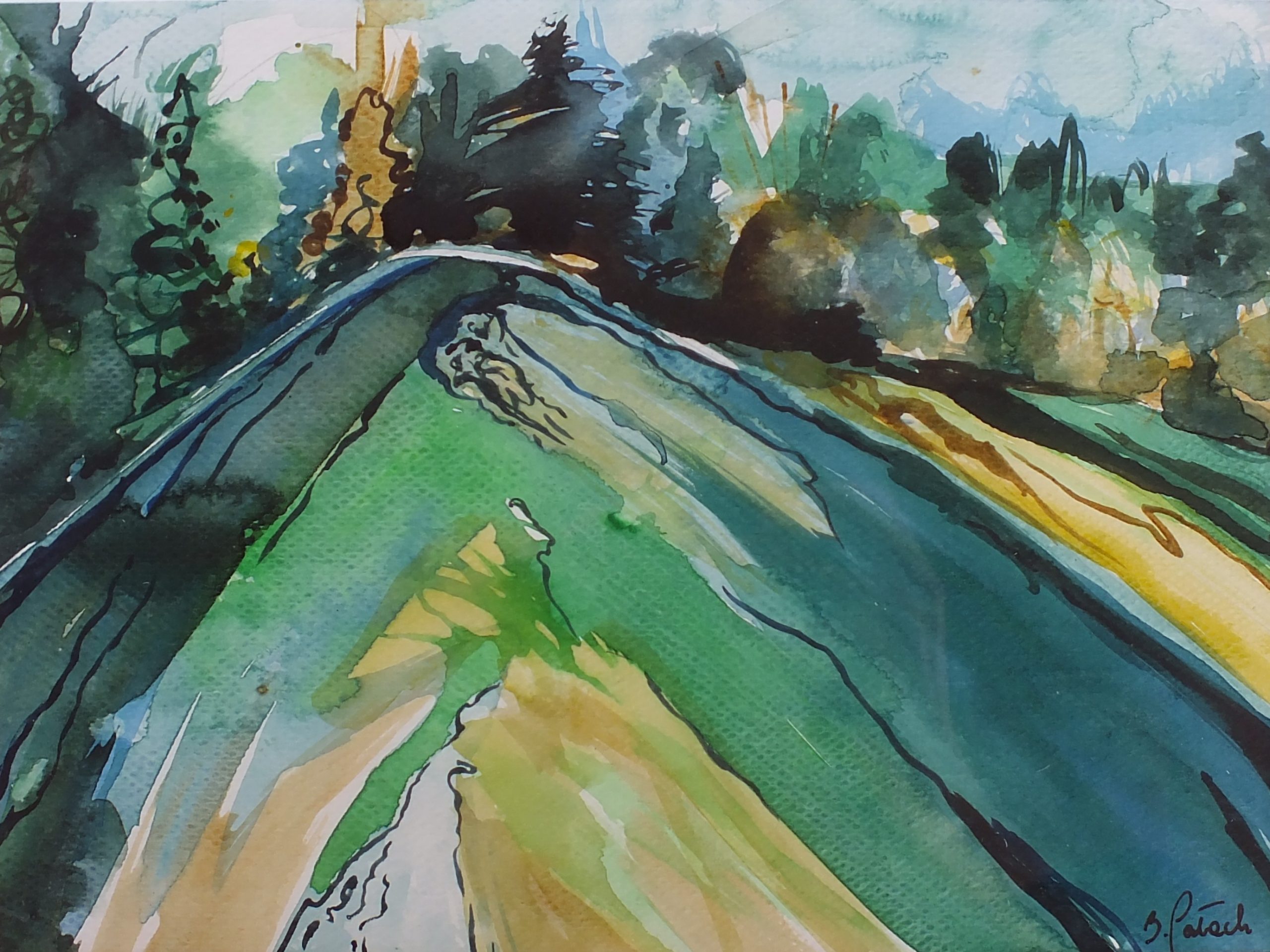
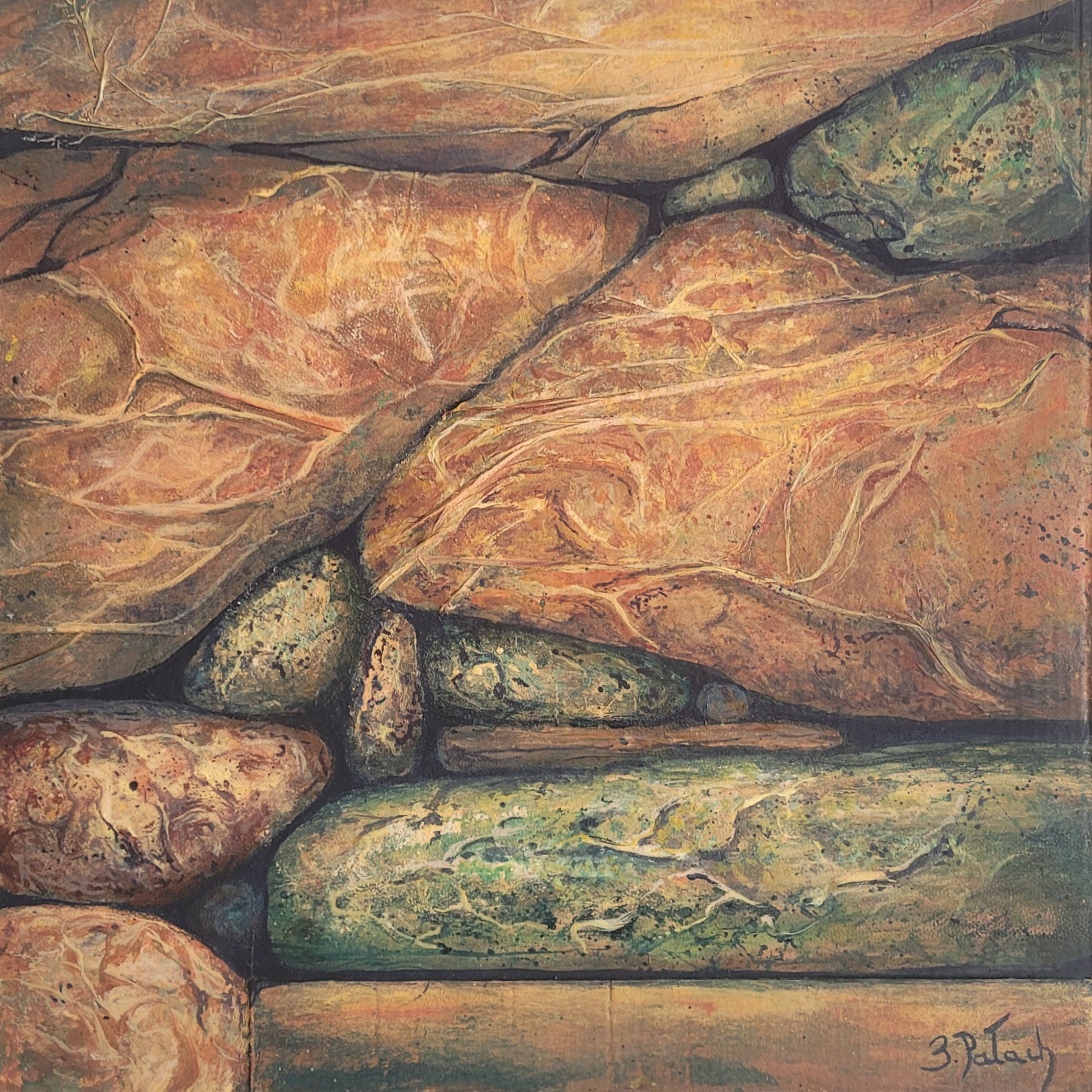
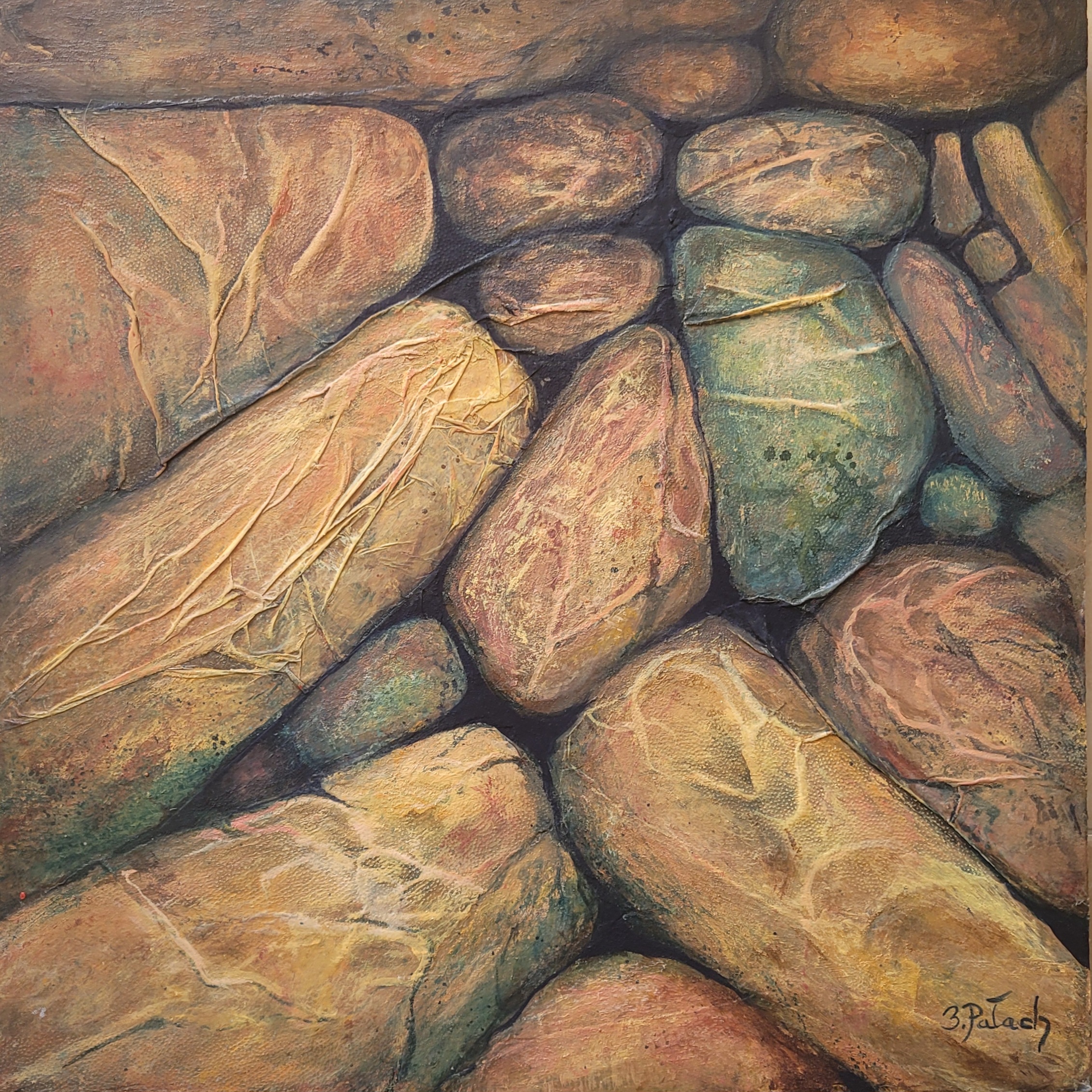
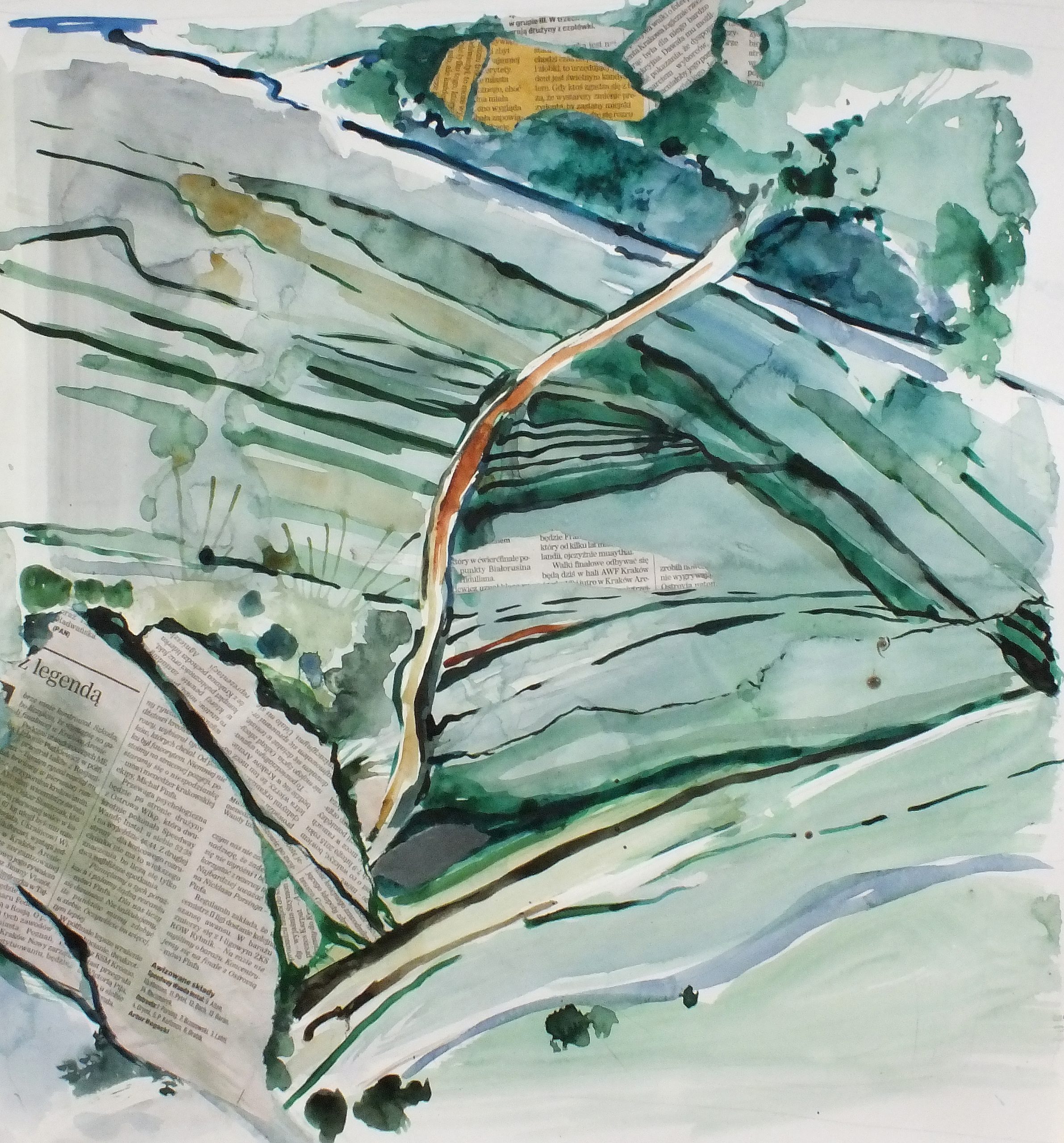
The “Earth” series was created using organic paints and natural pigments. Inspired by nature, I do not reproduce it literally but create my own organic forms – poetic records of the processes occurring in nature, its rhythms, its changes, and its hidden harmony. I delve into the depths of the earth, exploring its structure and concealed layers.
This series was created in 2025 and exhibited at SztuKaFe Gallery (Busko-Zdrój, Poland) and Garni Hotel (Kraków, Poland).


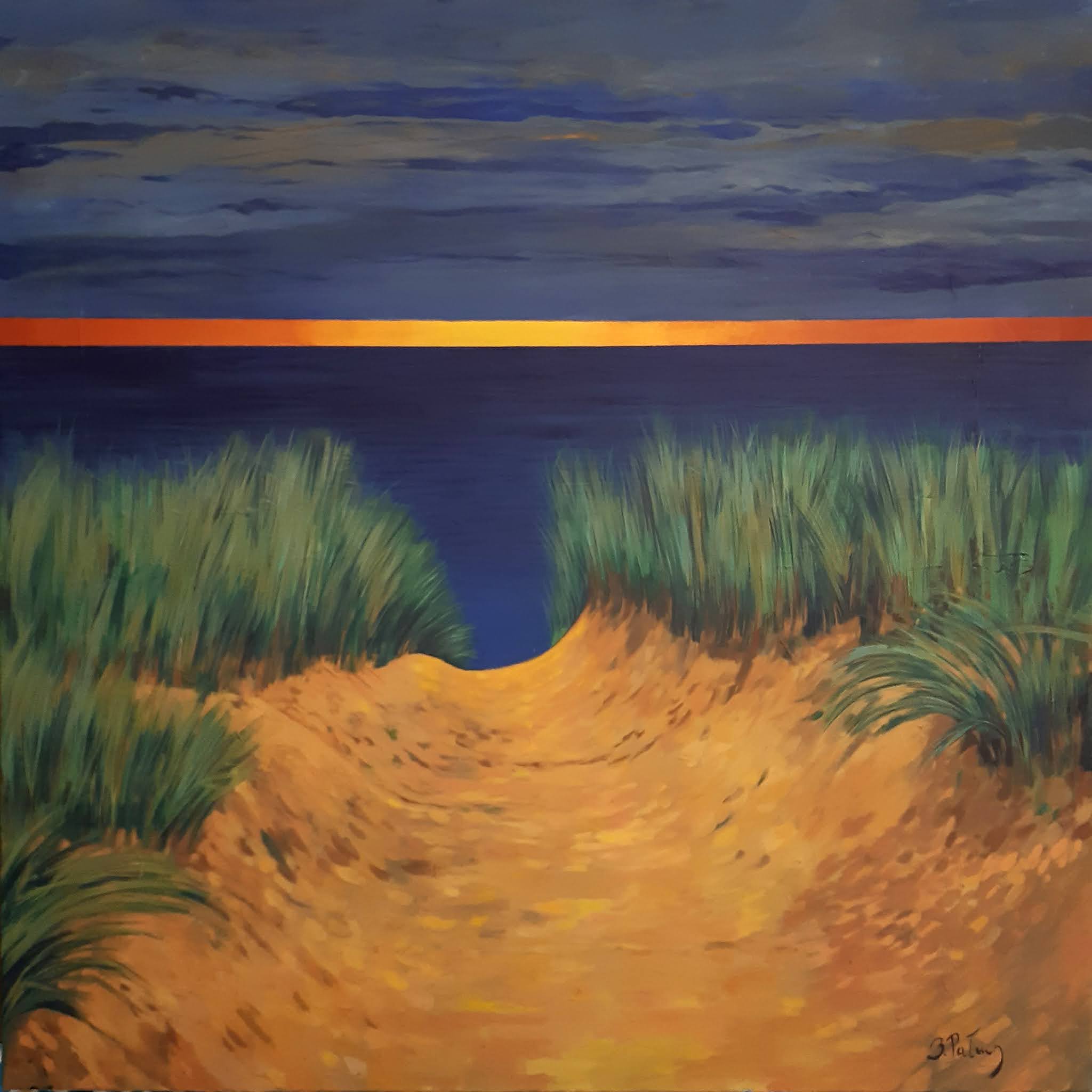
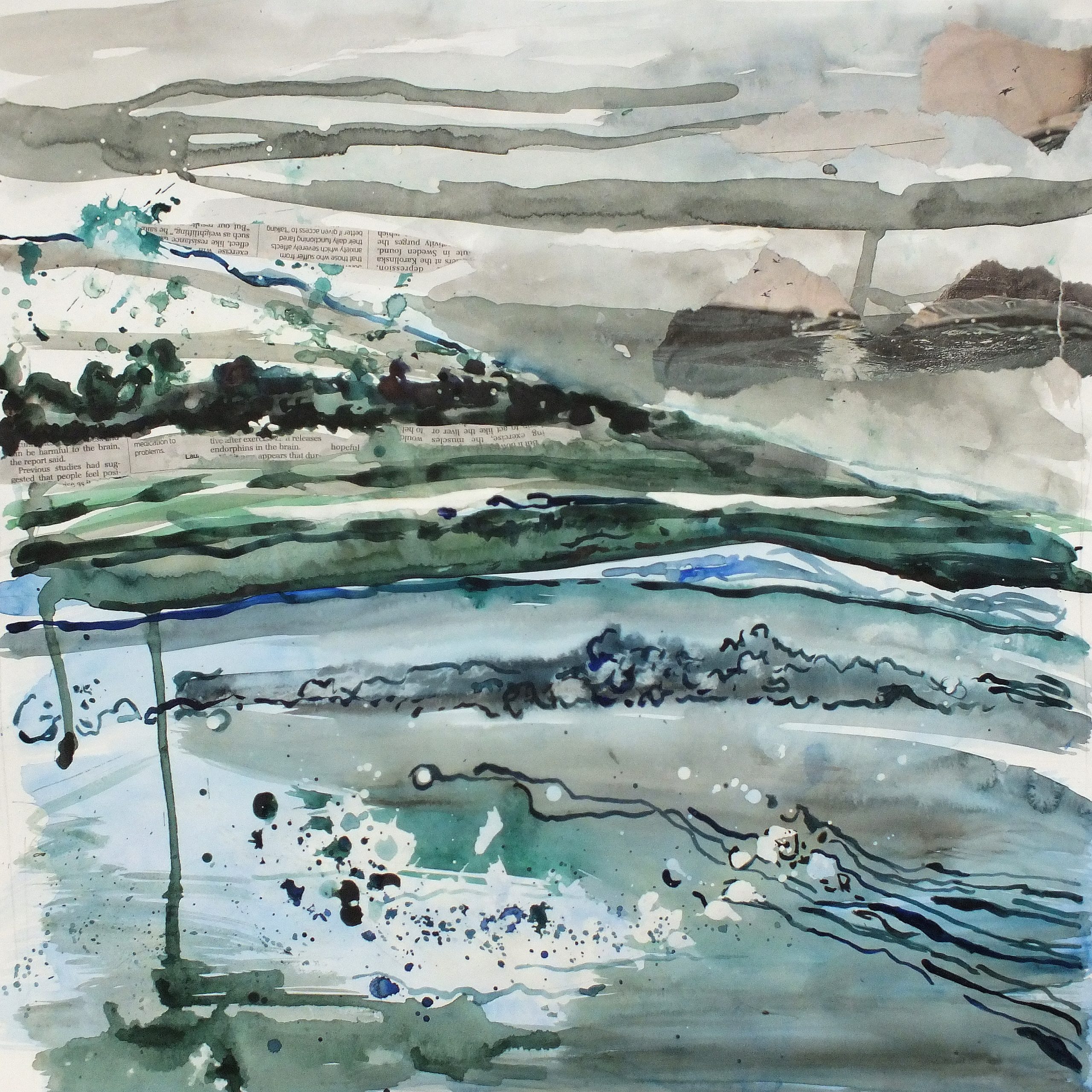
This series of painting captures a timeless dune landscape—not tied to any specific place, but evoking the essence of dunes everywhere. Windswept grasses cling to soft, shifting sands under a wide, open sky. Subtle textures reveal both strength and vulnerability: the fragile surface easily disturbed, yet standing firm against the sea’s encroaching power.
Each piece speaks of the delicate balance dunes maintain—simultaneously resilient and endangered. They are nature’s quiet defenders, protecting the land while harboring life within. A reminder that what seems gentle and temporary is often what sustains us most.


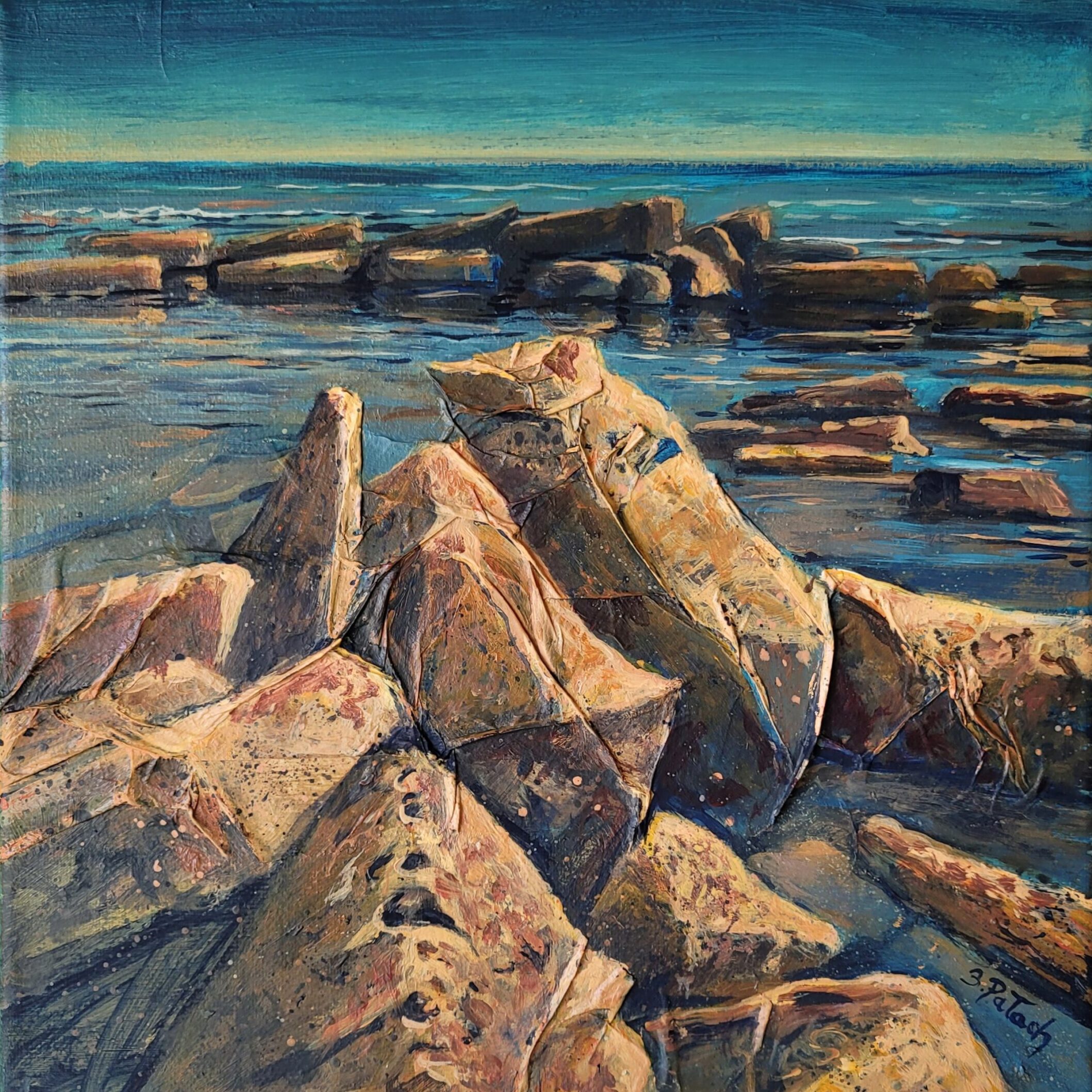
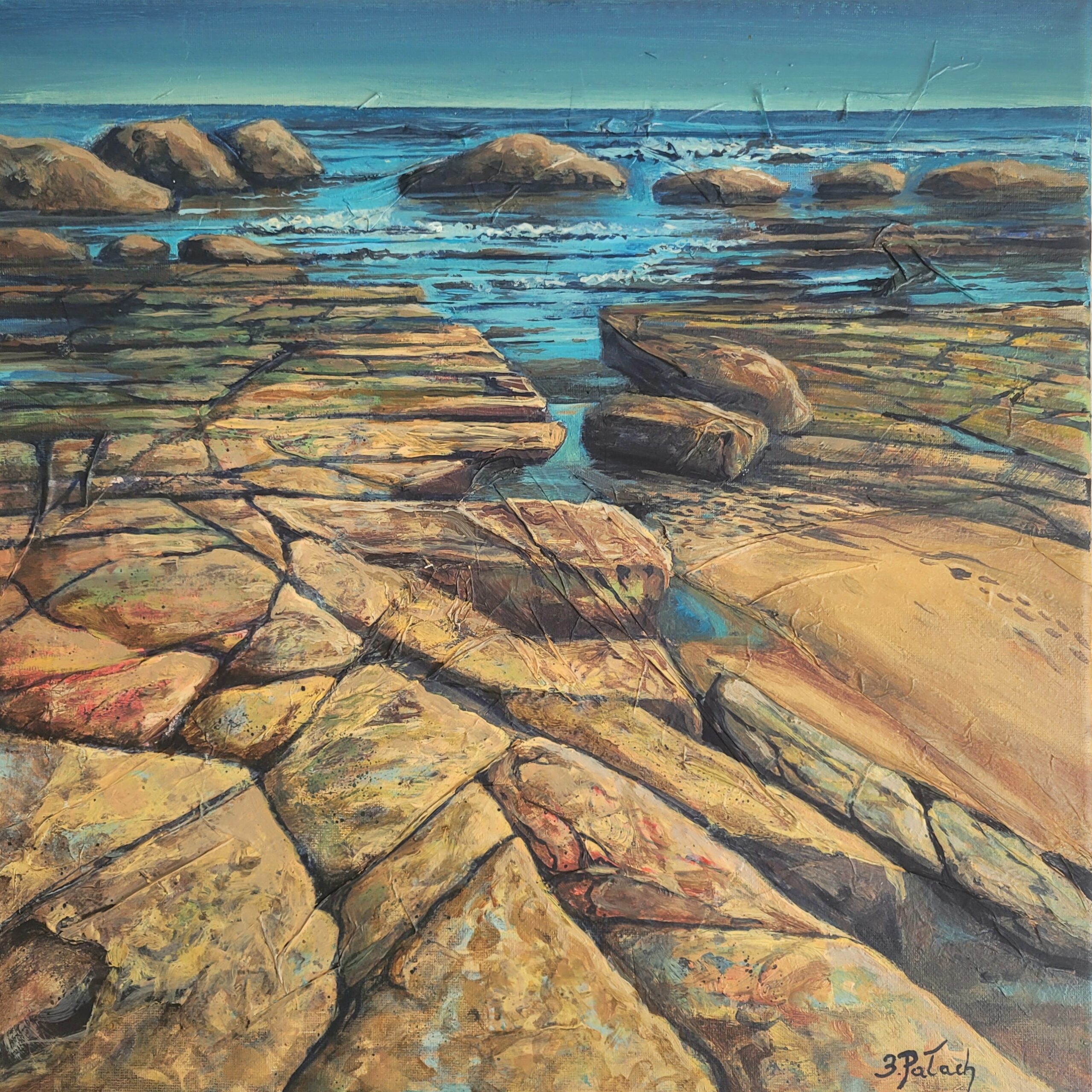
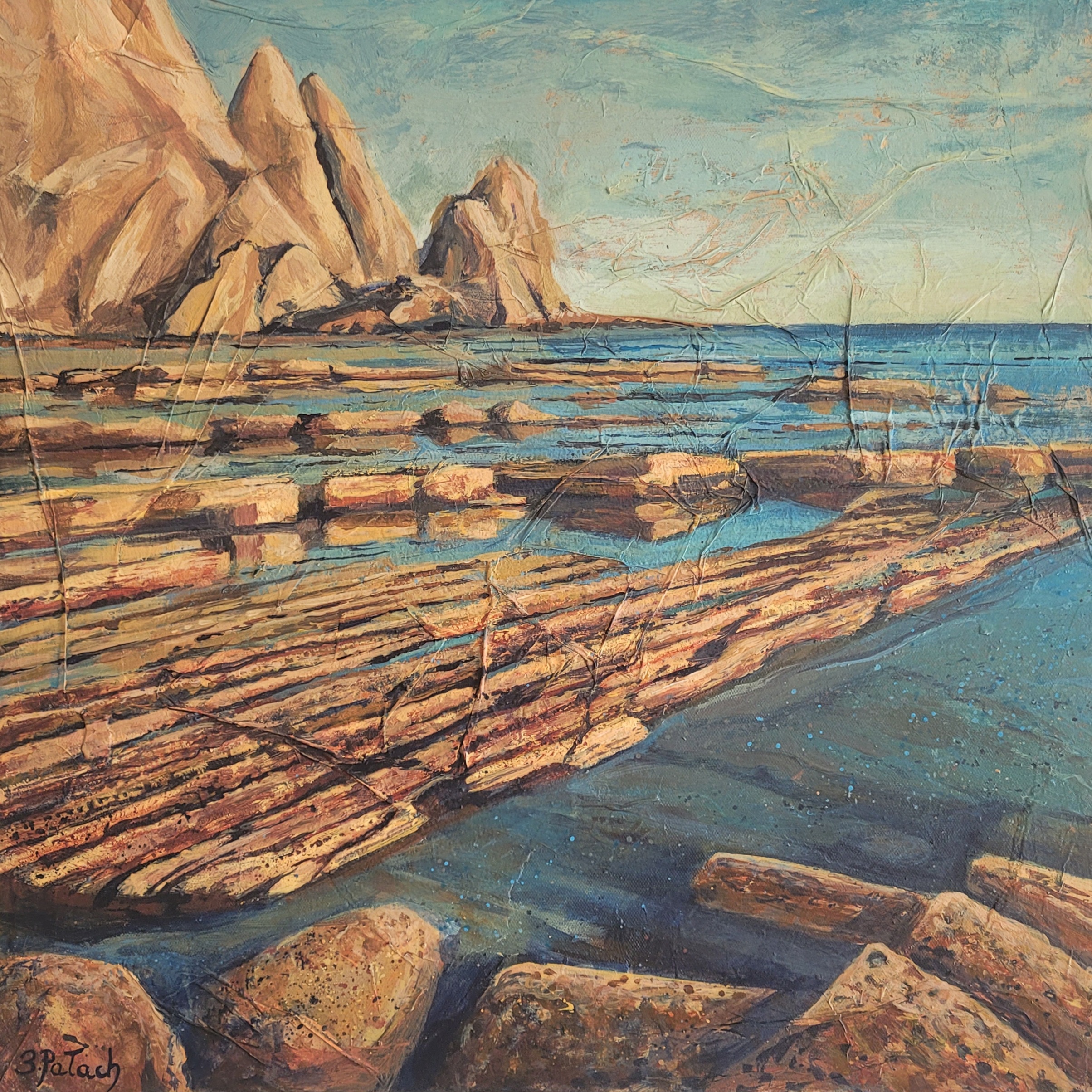
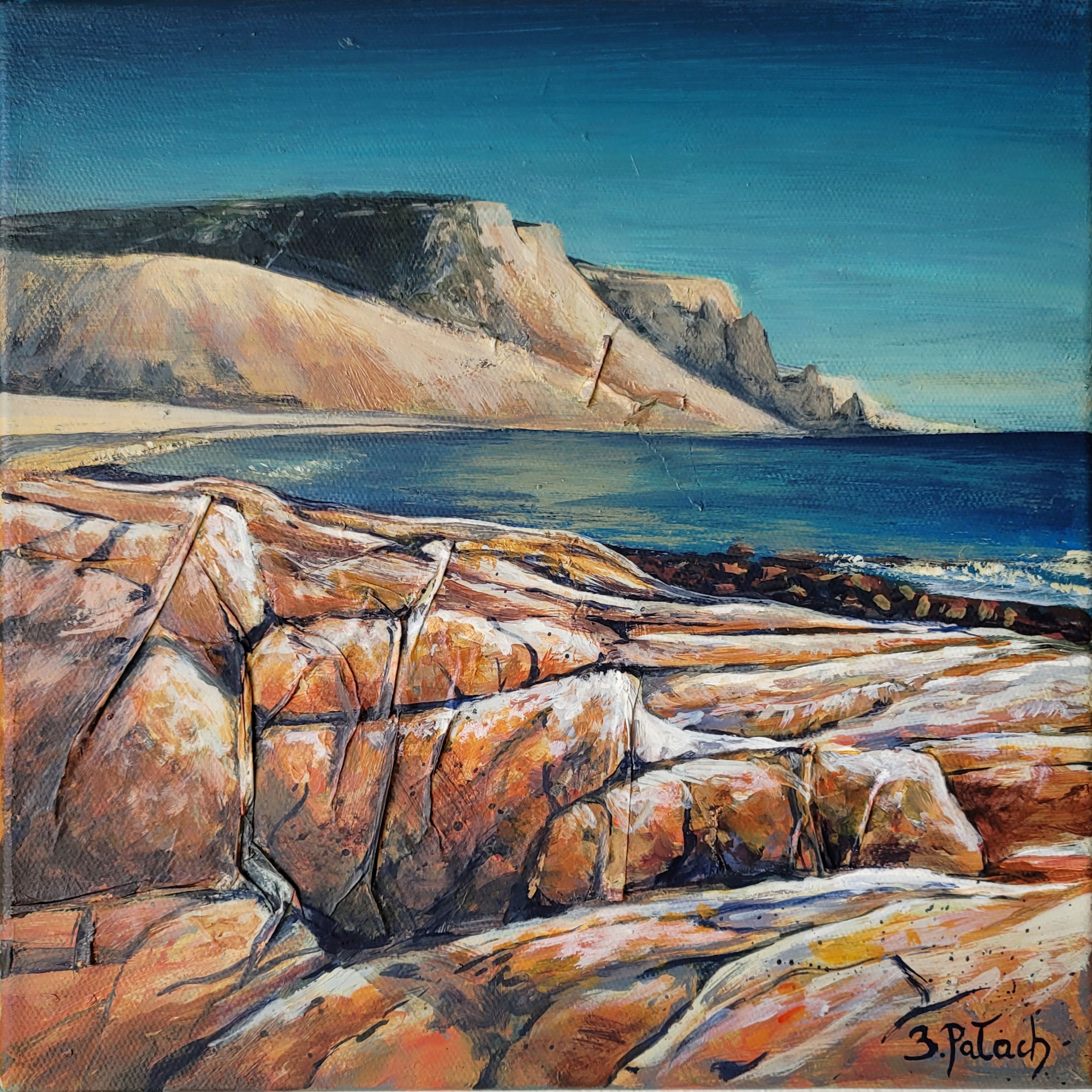
The moment I stumbled upon Algarve, situated in the southern part of Portugal, I was immediately captivated by its awe-inspiring landscape filled with remarkable vibrant colors of the sea, rocks, and vegetation. The sheer force of nature stole my heart and convinced me that as an artist, I could never recreate its genuine magnificence, no matter how hard I attempted. Instead, my goal is to emulate its creative process. The beauty of nature is beyond compare and serves as an enduring source of amazement and inspiration. Rather than replicating a specific location, my landscapes aim to convey a sense of mystery.
To produce this art collection, I worked with ecological art techniques, such as water-based watercolors and vegan acrylics, as well as repurposed local magazines into collages. I upcycled paper, old paintings and canvases discovered at nearby charity shops. My objective was to avoid contributing to the world’s waste by purchasing needless materials. Instead, I transformed unwanted objects into art that celebrates and honors the local environment.
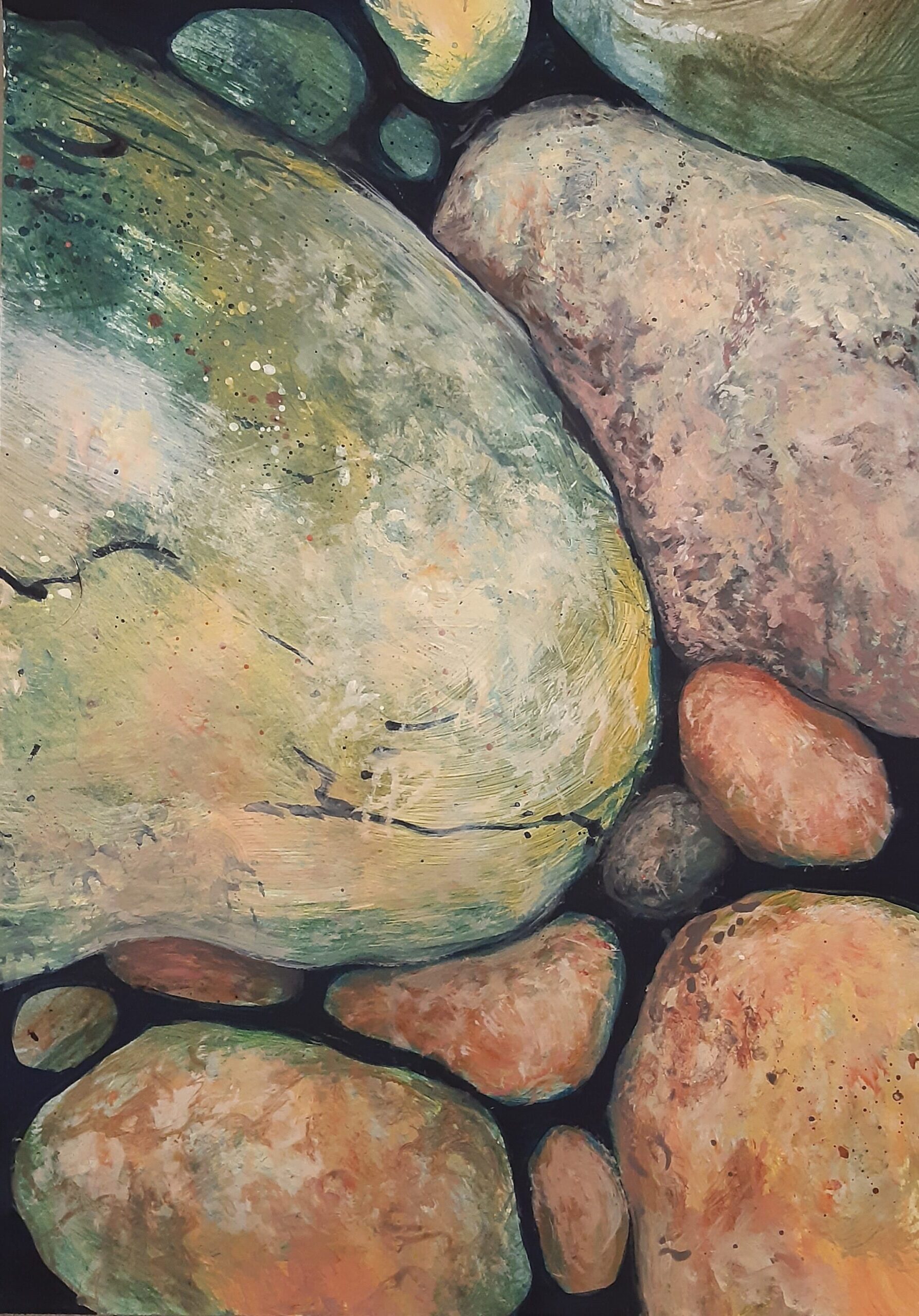
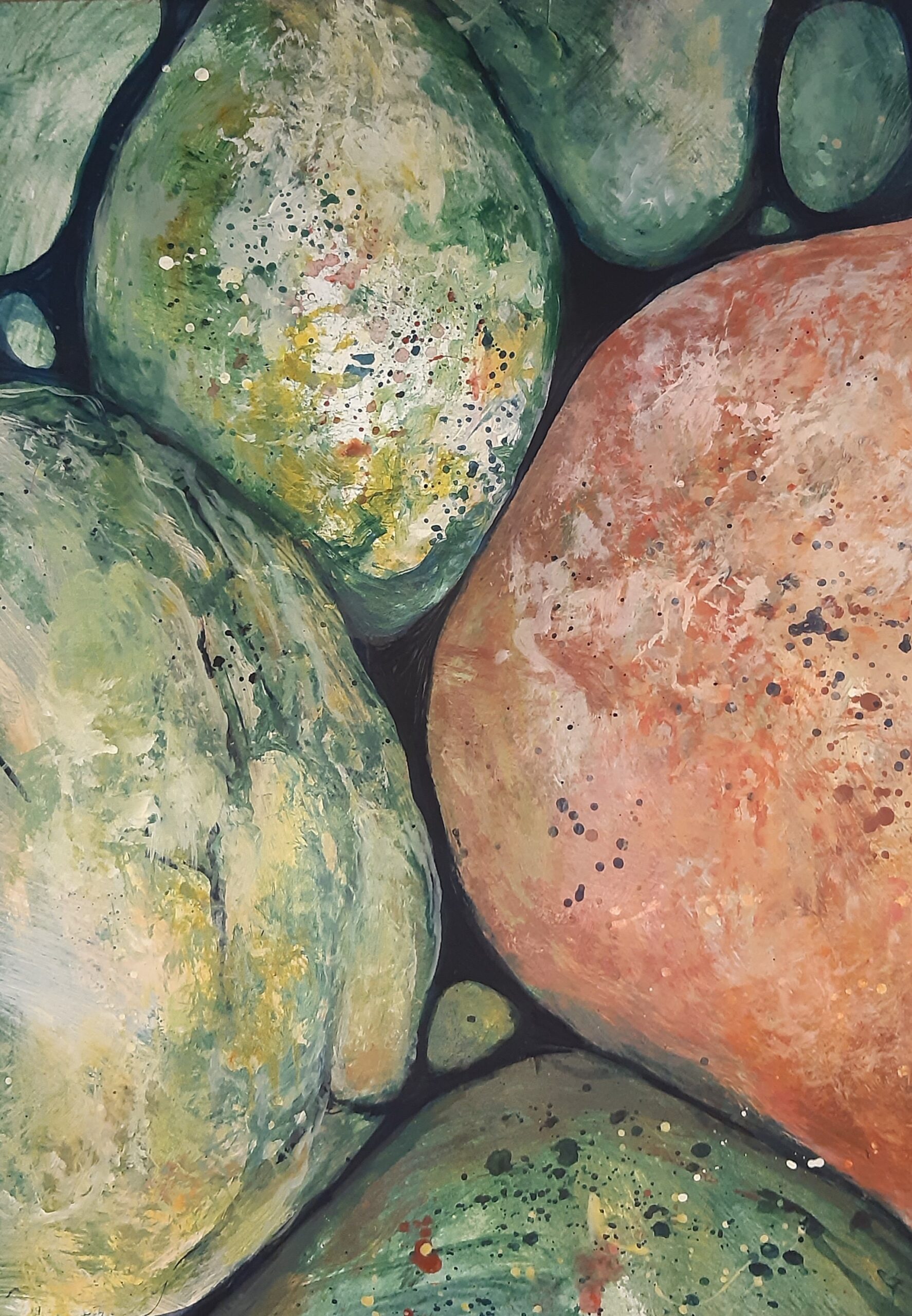
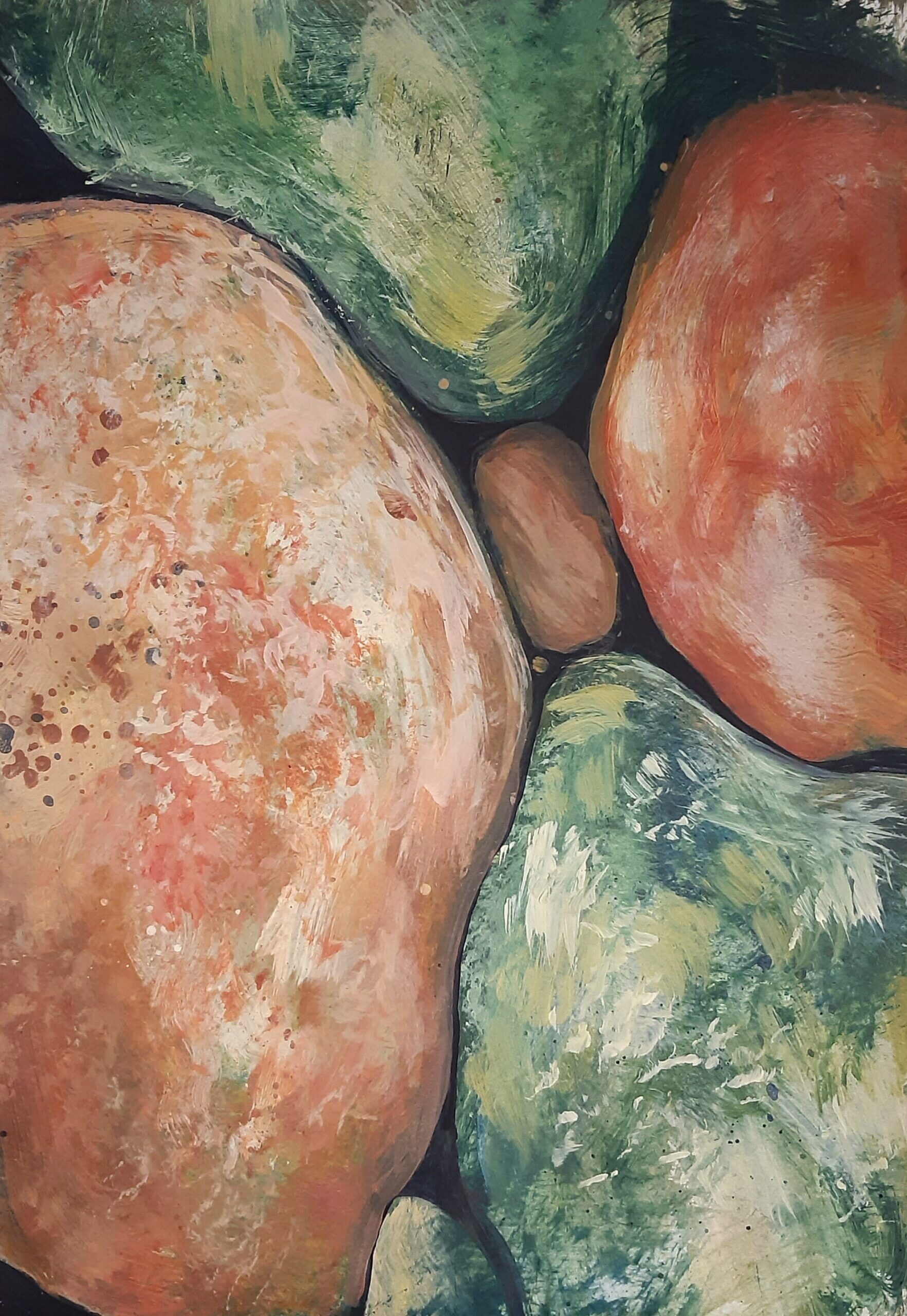
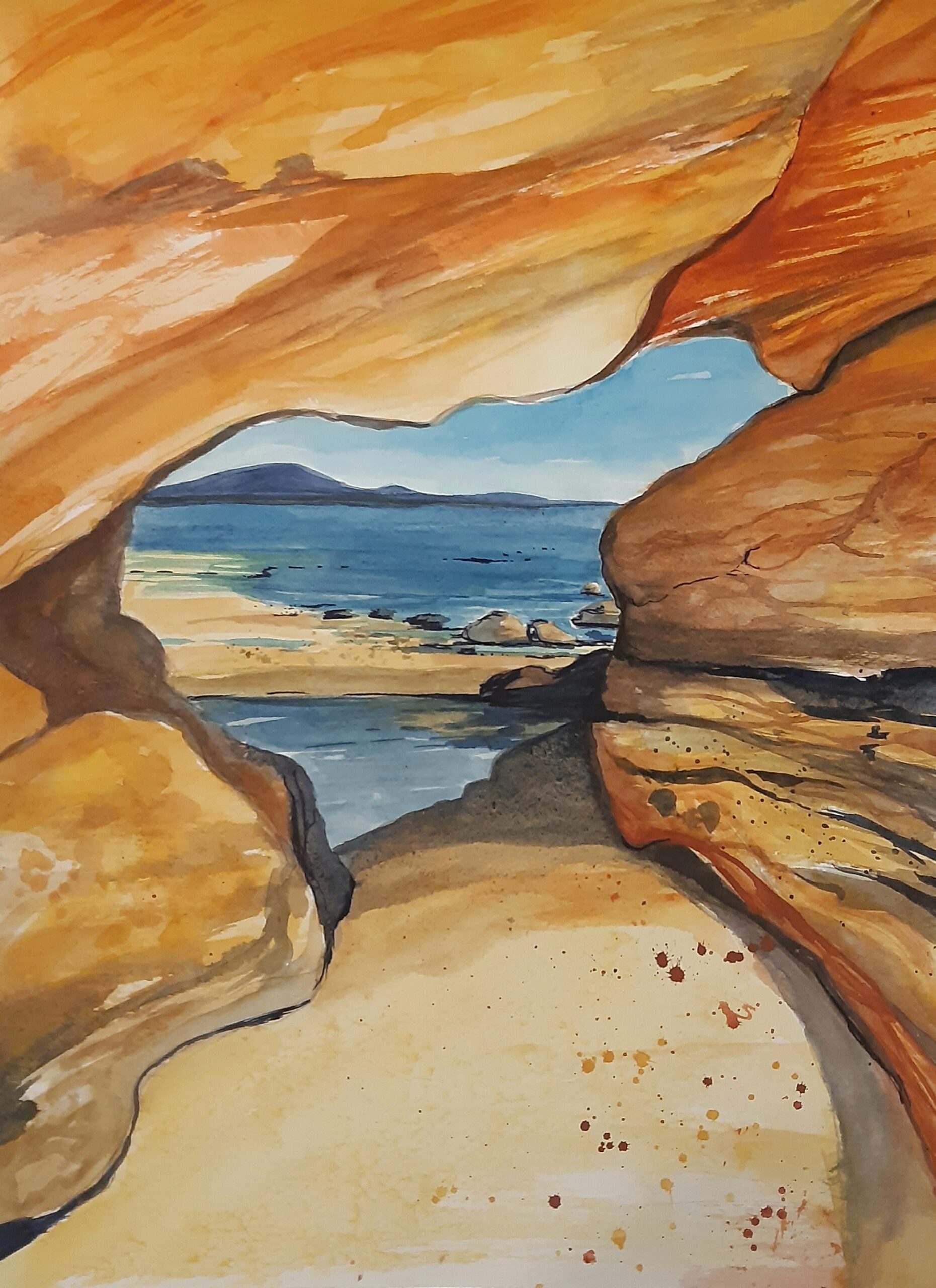
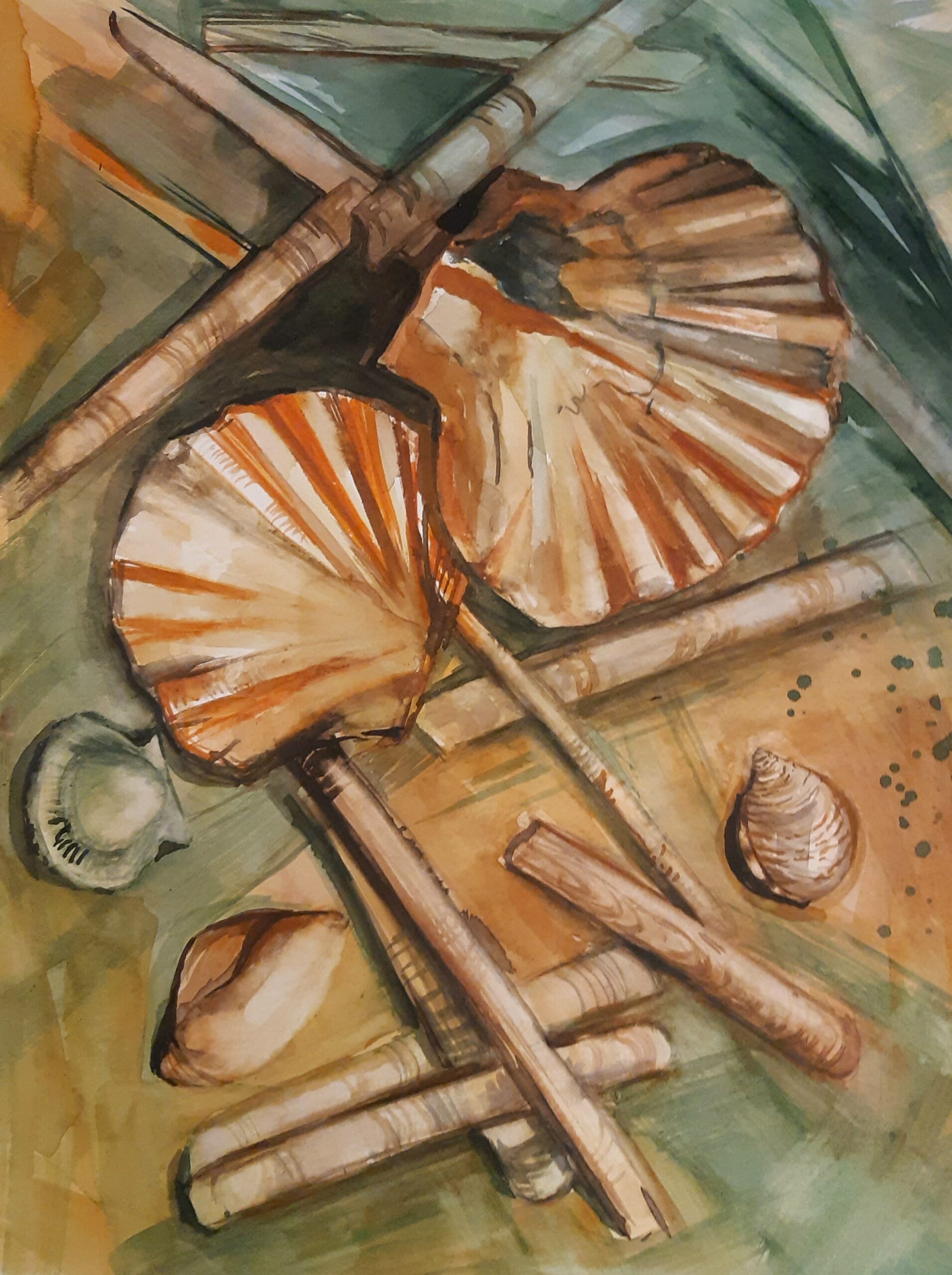
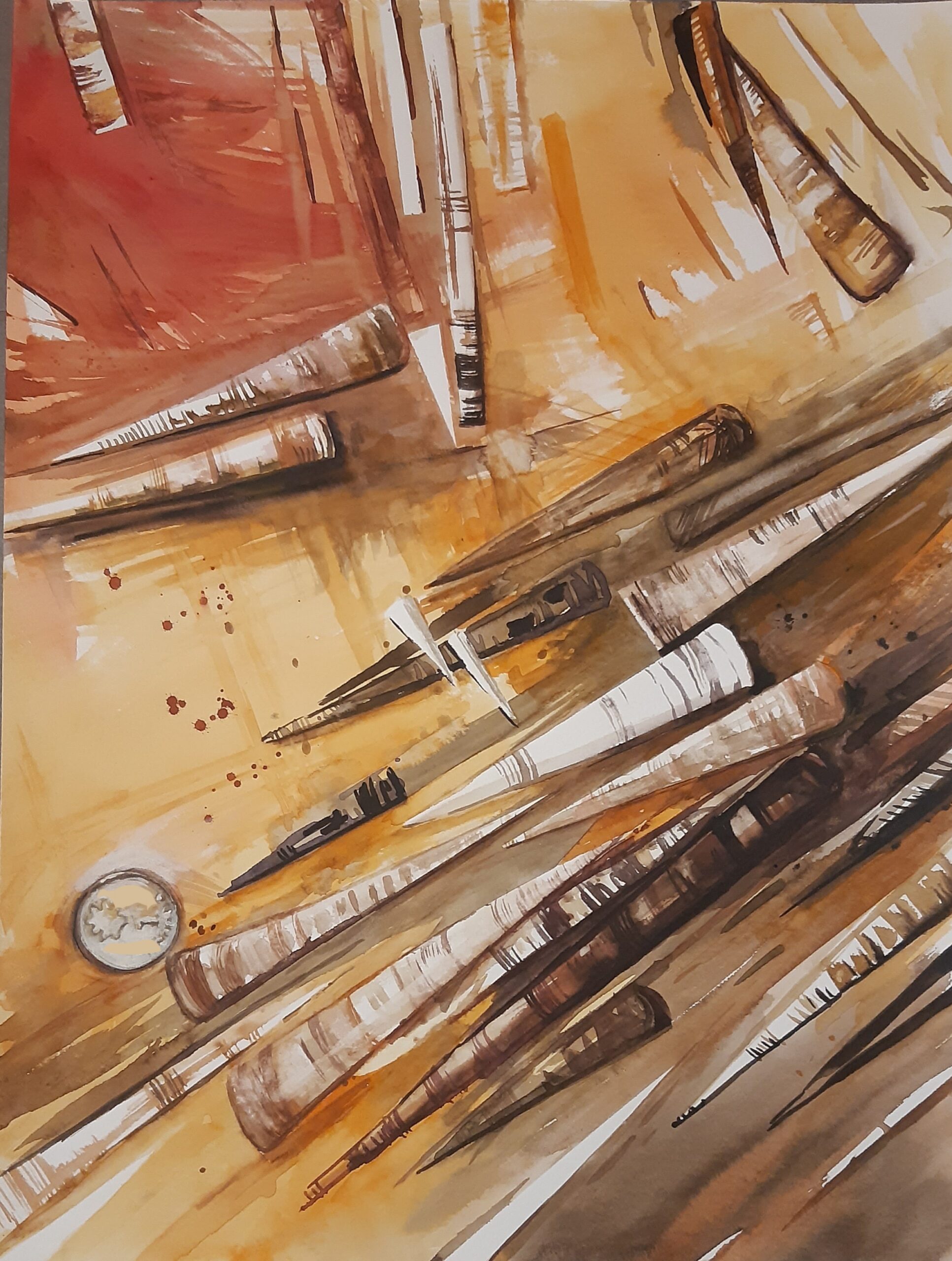
I was born in a charming little village nestled in southern Poland. From a young age, I was captivated by the beauty of the nearby forest, and spent every free moment exploring its depths. When I moved to Krakow, I was thrilled to discover the Wolski Forest, a protected wilderness teeming with life, and crowned by majestic hills that loomed above the city skyline. The forest’s rocks, sculpted into stunning formations, never ceased to amaze me, and its lush enclaves provided a refuge for an array of wildlife. Whenever I needed to escape the hustle and bustle of city life, I sought solace in the tranquil embrace of Las Wolski.
Towards the end of 2022, I embarked on a new adventure, relocating to the sun-kissed shores of southern Portugal. The Algarve region dazzled me with its awe-inspiring landscapes, adorned with striking cliffs and rugged rocks. The warmth of the sun filled me with a sense of renewed vitality, and I was humbled by the raw power of nature that surrounded me.
For me, the allure of both these places is simply indescribable, and I am always eager to return to them. Despite the fact that they are separated by kilometers, they are connected by some incomprehensible mysticism. Maybe it’s the memory of the earth for millions of years, or maybe it’s the stories created in people’s minds that try to explain the secrets of these landscapes.
Let me tell you the stories that have built those places. It is truly something magical to experience. From the origin of Panienskie Skaly Rocks in Wolski Forest of Krakow to the legend that thrilled a small fishing village in southern Portugal.
The Moorish Floripes is a legendary figure from Olhão (Portugal). She appeared to two men near a water mill and told them she was trapped by an enchantment. To lift the enchantment, a man must embrace her by the river, cut his arm at the level of his heart, cross the ocean with two candles to Africa without them dying, and then marry her. Some Olhao residents believe in the legend so much that they say Floripes appears during the day and pays for her purchases with a gold coin, disappearing without waiting for her change
The Scallop Shell is an iconic symbol of both the Spanish and the Portuguese Camino de Santiago. It’s associated with St. James, and one myth says that medieval pilgrims used it as a replacement for a bowl to hold food and water. Another legend claims that the apostle rescued a knight covered in Scallop Shells, and while St. James’ remains were being carried to Galicia, a knight’s horse fell into the water and emerged covered in shells. The Shell is a metaphor, representing the different routes traveled by pilgrims from around the world that all lead to the tomb of St. James. It’s used to guide pilgrims and worn as a symbol of identification and reassurance.
Walking along the beaches of the Algarve you can come across these little masterpieces. They stand out from other shells with their symmetrical, perfectly proportioned shape, reminiscent of the rising sun – for me a symbol of rebirth, hope and new opportunities.
“Remembrance Stone”
As a resident of Krakow, I was fortunate enough to encounter a plethora of fascinating stories surrounding stones. I was enamored by the splendor of the Jurassic rocks that adorned the Wolski Forest, enveloping the city with their timeless beauty. While living in the Jewish quarter, I stumbled upon a hidden gem, a wild and picturesque Jewish cemetery, embellished with numerous stones, or matzevot, bearing testament to the memories of the departed. According to Jewish custom, visitors to the gravesites often place a stone, brought with them as a token of remembrance and respect for the deceased. It was during my time in Krakow that I first heard of a peculiar superstition – that bringing stones into one’s home was considered taboo. The belief was rooted in the notion that stones accumulated the energy of various individuals and sources, thereby carrying with them the potential for bad luck. For me, however, stones were a glimpse into history, bearing witness to thousands of years of natural wonder and unmatched beauty. I adored rocks, considering them to be miniature representations of the majesty of nature. Although I am sometimes inclined to bring home a stone I discovered on the beach or in the forest, I rather leave it in their natural environment, to be admired by others who stumble upon its enchanting allure.
The legend of Praia da Rocha
Once upon a time, there were two giants of the Sea and Mountain who lived in perfect harmony. Thus was until the day a mermaid arrived… Her charm and enchanting songs caused the two giants to fall in love with her, who wanted her each for themselves, causing a terrible battle for the siren to broke out. The ferocious sea created huge waves, and the rocks mad with anger became even bigger. The mermaid, who was also madly in love with both the Sea and the Mountains, could not decide what to do. All of a sudden, she turned into fine golden sand in order to spend her life with both of the giants. It is now said the landscape was transformed by this battle for love and formed the Praia da Rocha, located just outside Portimao and one of the most famous in the Algarve.
“Panieńskie Skały”
In the Wolski Forest , located within the Zwierzyniec district of Krakow (Poland), there is a nature reserve known as Panieńskie Skały (Maiden Rocks). According to the legend, in the 13th century, the Norbertine nuns who were fleeing from the Tartars from their monastery in Zwierzyniec sought shelter here. When the attackers were close, the sisters prayed to be saved from rape and death: together with the surrounding rocks, they sank into the ground (other versions say that the sisters were turned into rocks). There is also talk of a chamber hidden under the rocks – this is where the saved Norbertine nuns gather for prayer. Apparently, until recently there was a crack in the rocks through which you could look into this underground monastery and see the nuns sleeping in it. Maiden Rocks is a place that delights regardless of the season. This is one of the most beautiful wild alleys of the Wolski Forest with a picturesque gorge and limestone rocks emerging from time to time, wrapped in tree roots. The paths meandering between ancient trees lead alternately up and down.
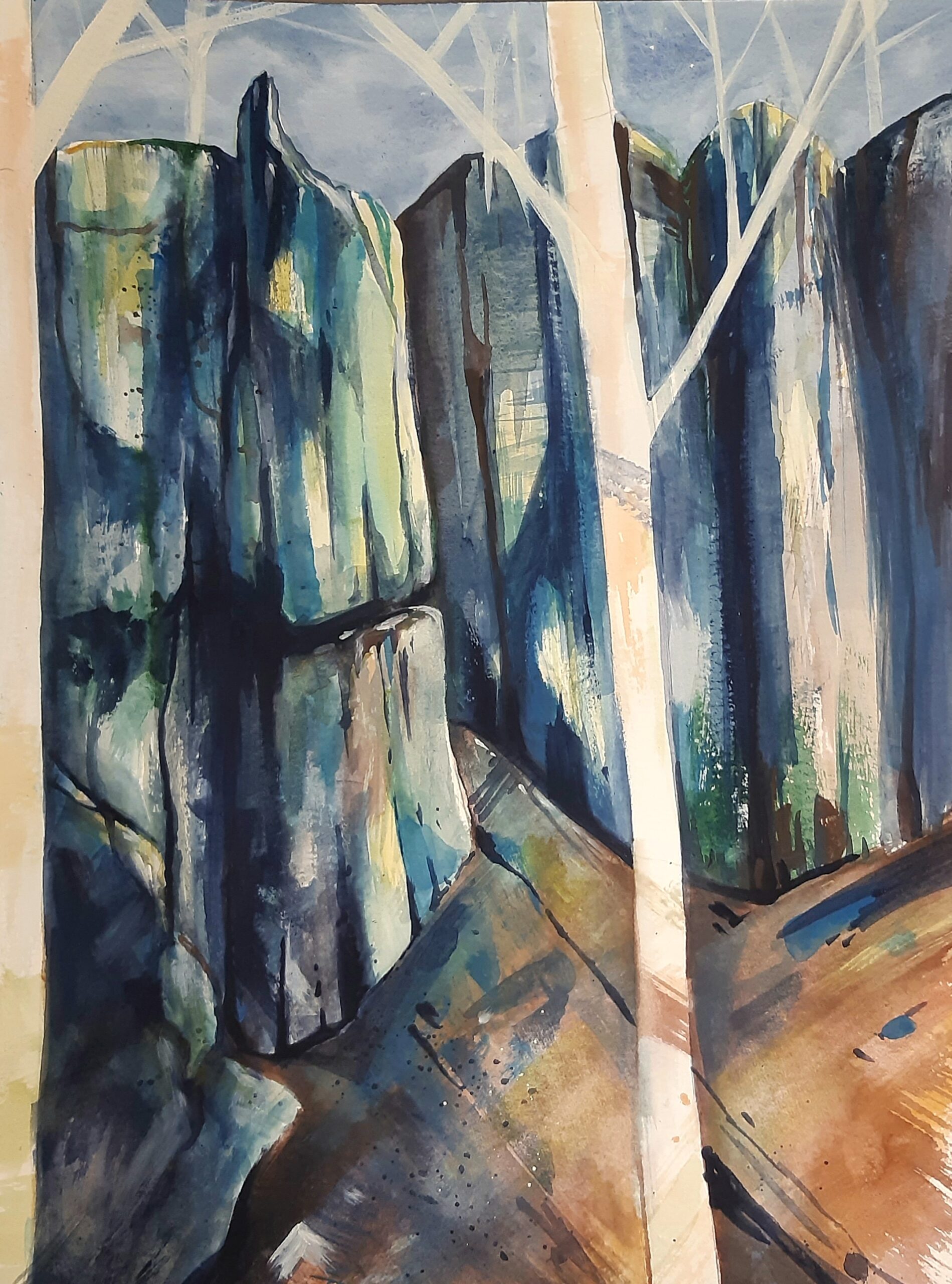
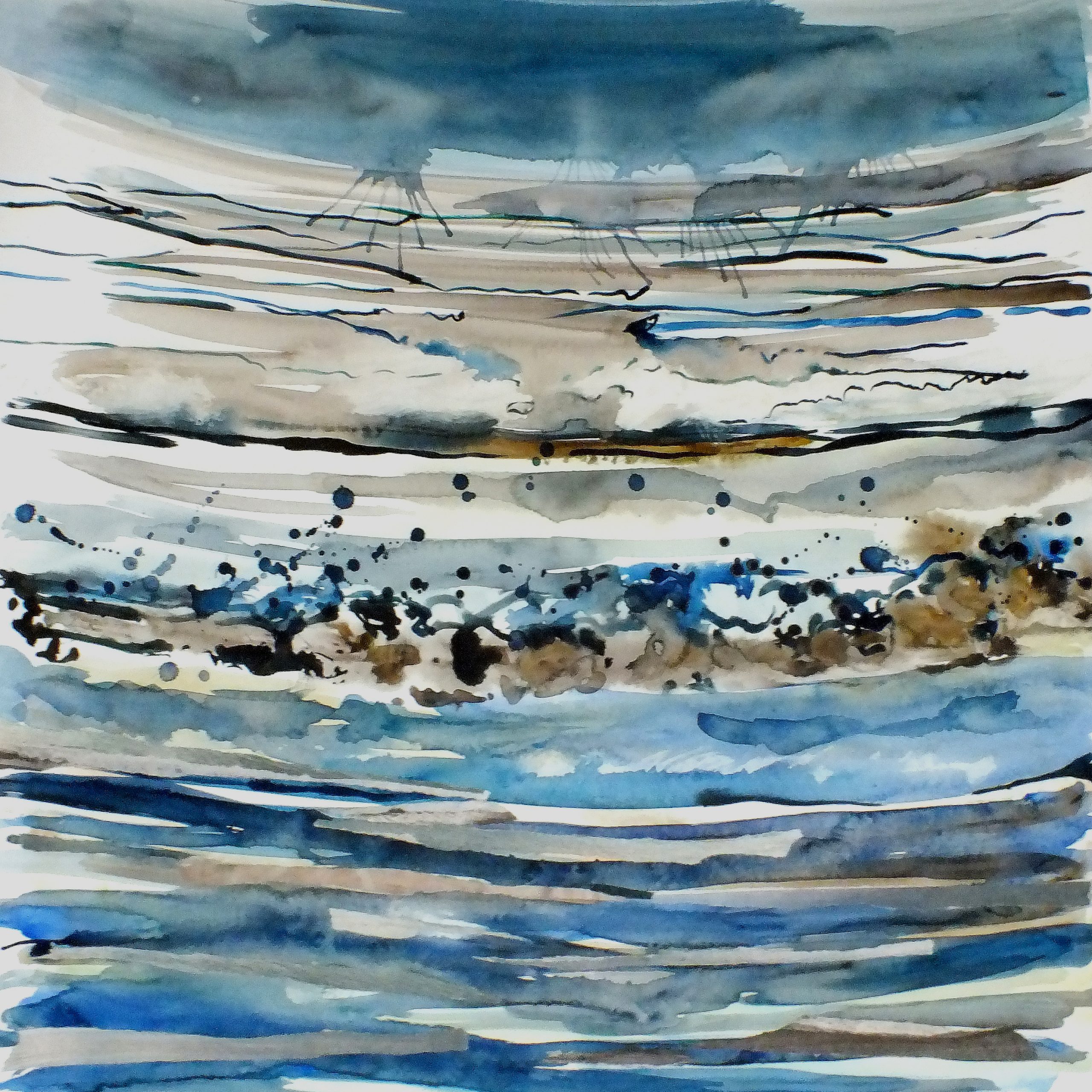
My work is deeply inspired by the breathtaking landscapes of the Algarve—the ever-changing light, rugged cliffs, and the endless dance between land and sea. Using watercolours, I aim to capture the essence of this region, allowing the fluidity and transparency of the medium to reflect the organic beauty of nature.
The heavy washes and gestural brushstrokes in my paintings echo the textures of the coastal rock formations, the movement of the waves, and the warm hues of the Algarve’s sunlit scenery. My creative process is intuitive, shaped by the rhythms of nature, the play of shadows at different times of the day, and the emotions evoked by a place that feels both wild and serene.


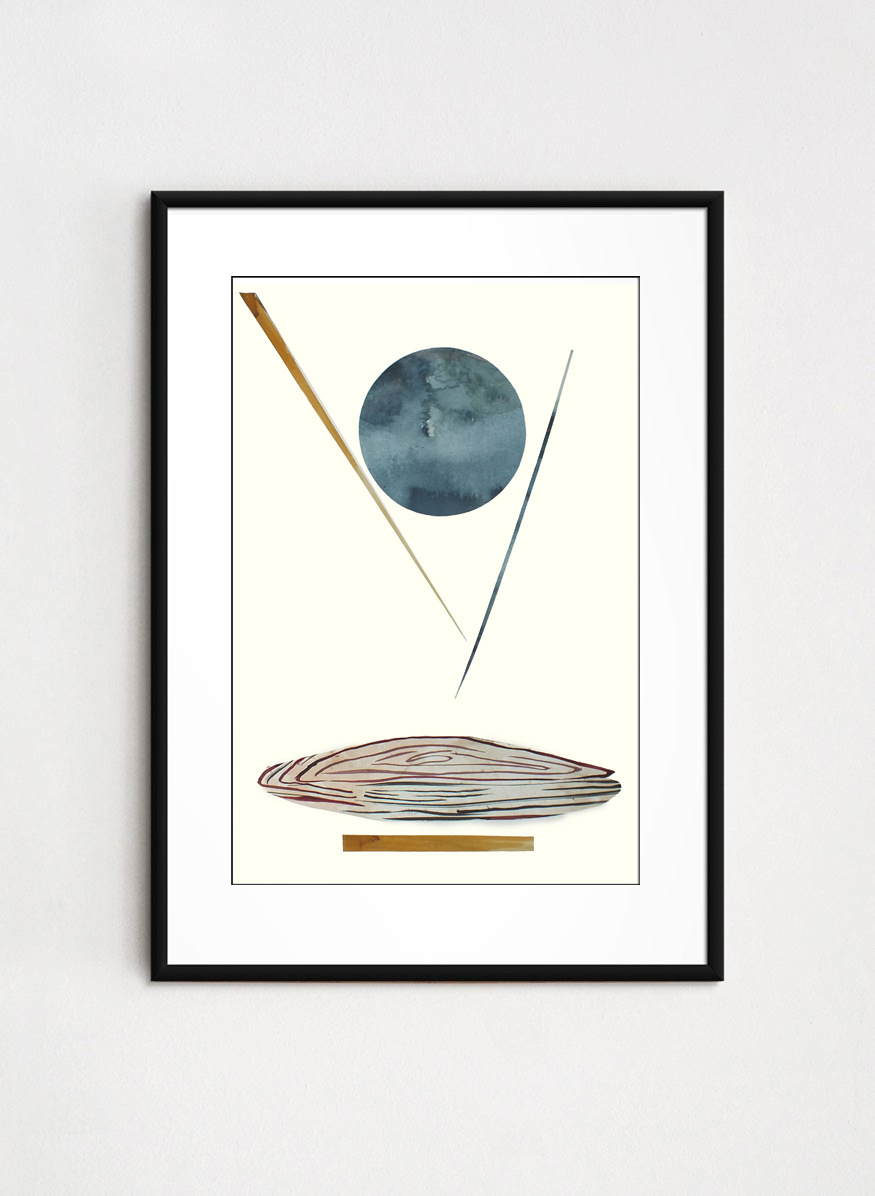
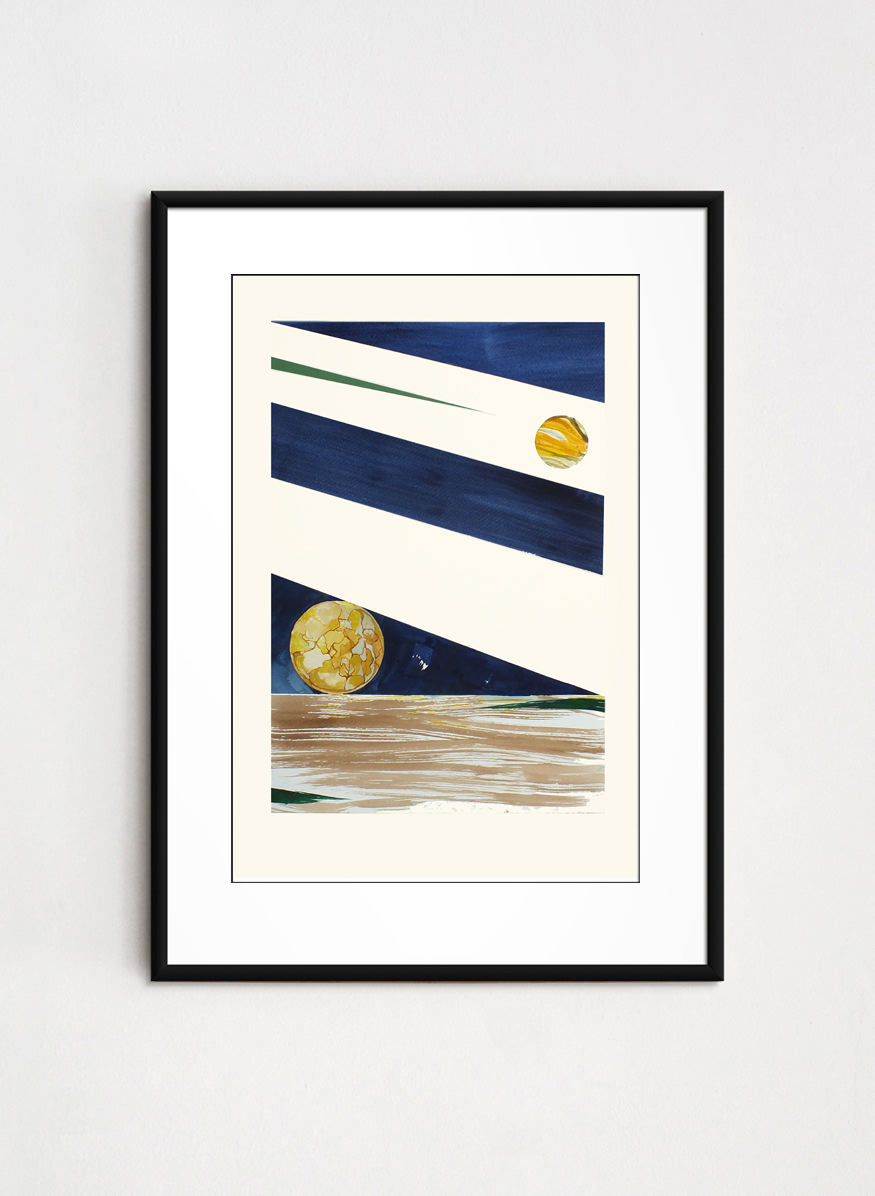
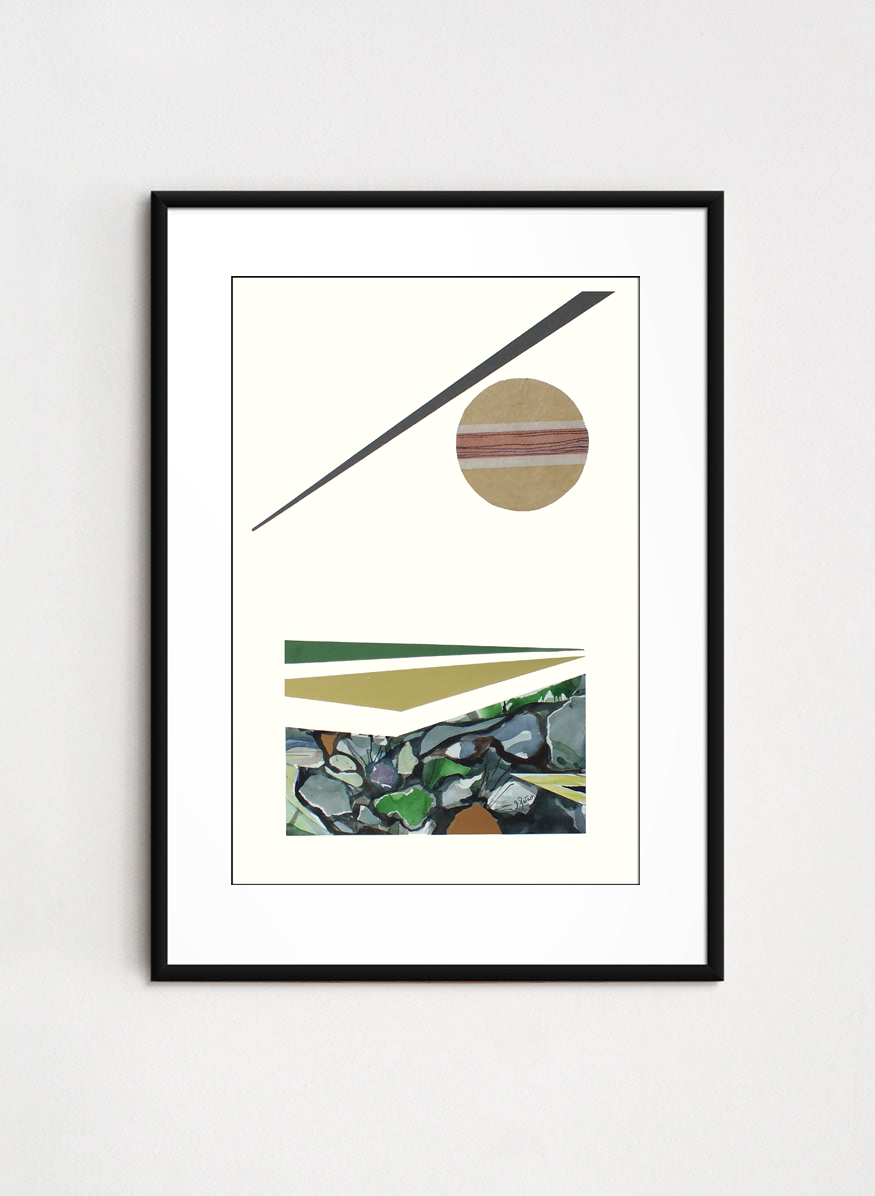
A work of art expresses nothing. A work of art is not a sign of anything. It is (it exists) by itself. Władysław Strzemiński
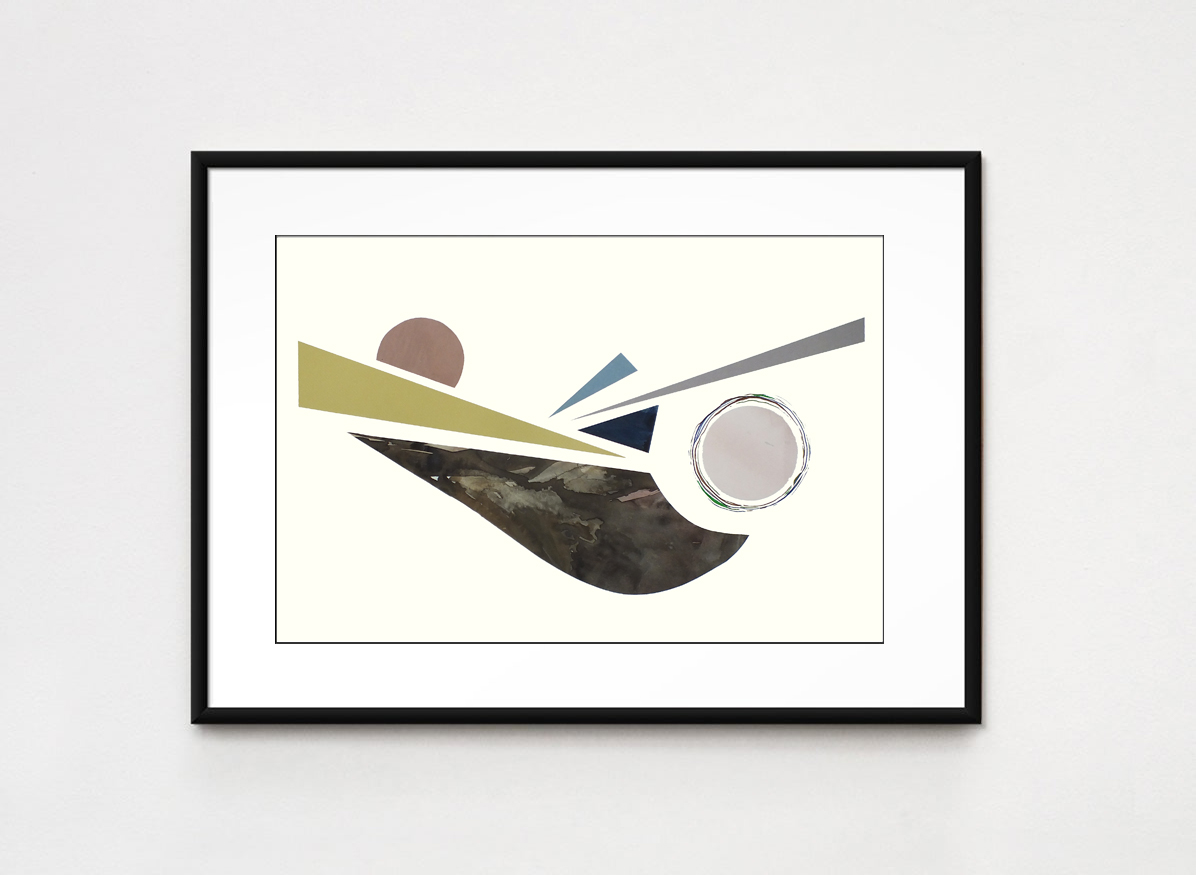
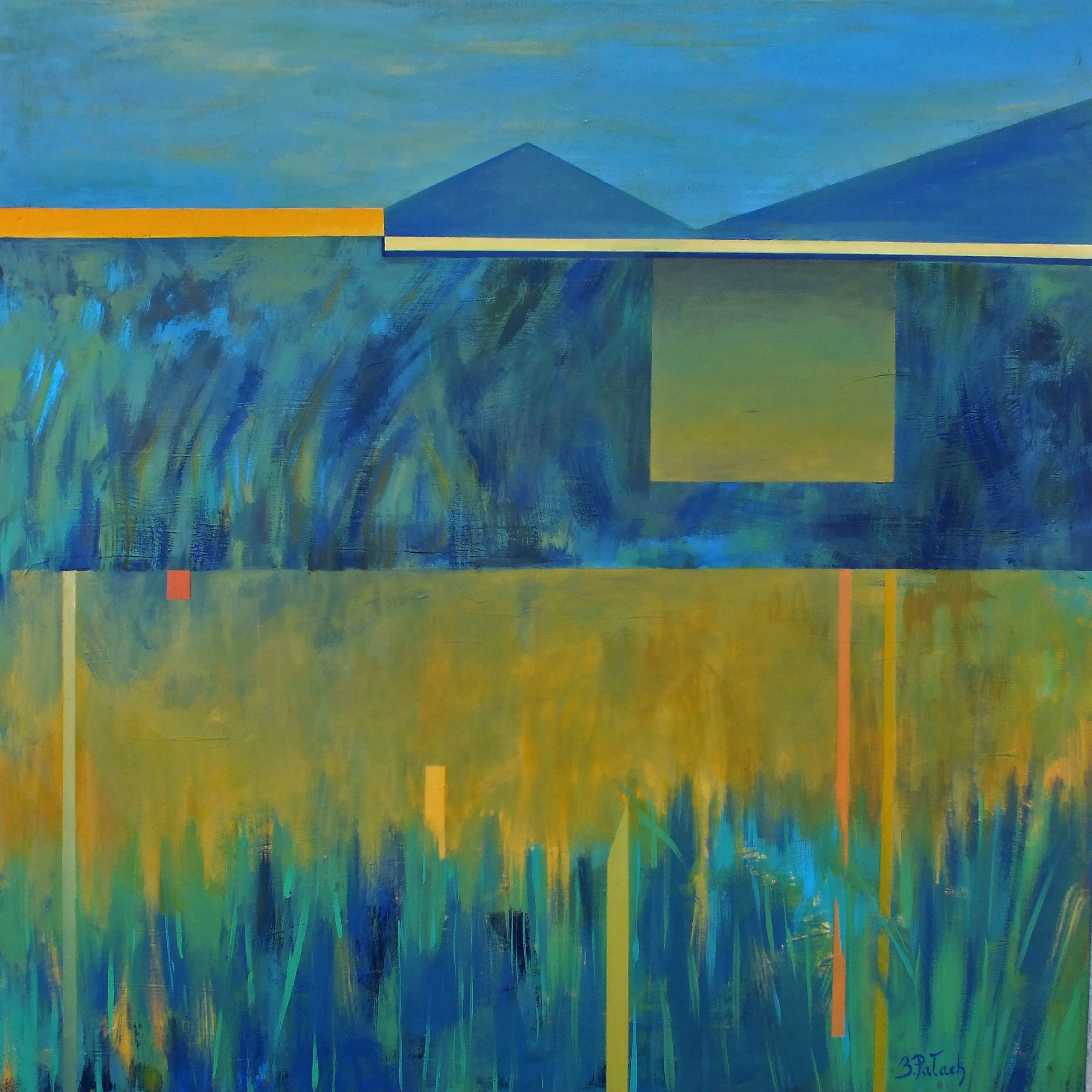
The “Simply, picture” series was made as a result of my fascination with the art of Polish Avant-garde artists of the 20th century, especially Katarzyna Kobro, Edward Krasiński, Władysław Strzemiński and Henryk Stażewski. What I value most in the work of these artists is their striving for pure visual art, which affects the recipient not through specific objects presented in the picture, but only through artistic elements, such as colour, shape and composition. Their abstract paintings were liberated from the constructivist rigors of utility and practicality.
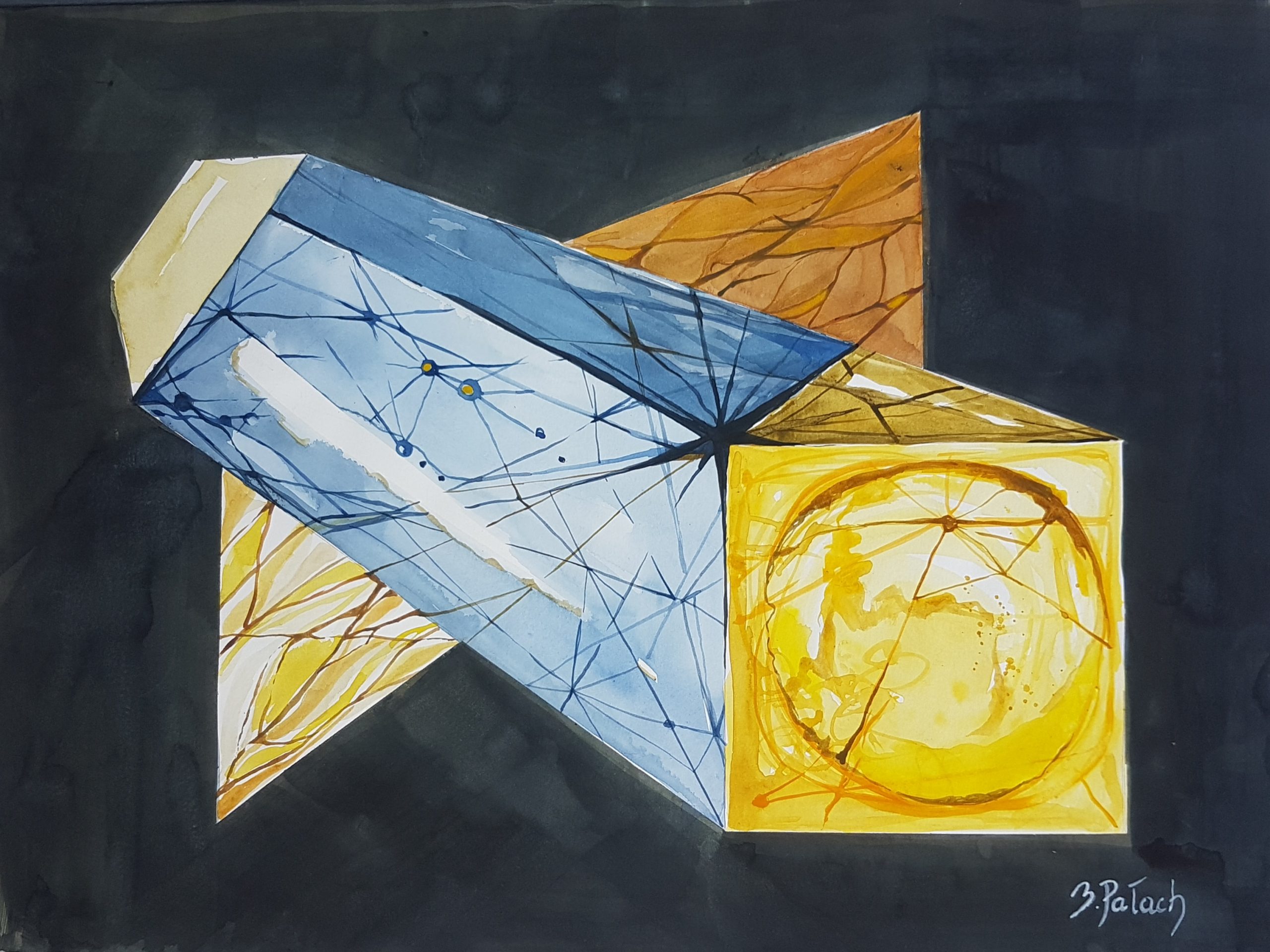
In accordance with the assumption that the image is to be an image and nothing more, I reached for the experiences of supremism and geometric abstraction. In my paper collages, I deliberately gave up chiaroscuro and perspective in favor of a raw, pure shape and strength of color. I did not want to imitate convexity and create an impression of depth – as in classical painting – on the contrary, my goal was to emphasize the flatness of the paper surface and its delicate structure. Contrast is based on a combination of forms and colours and their differences in energy. Irregular, organic stains enclosed in a simple geometric figure in relation to warm colours, can have a soothing and calming effect. In turn, dynamic, sharp triangles “thrown” between soft watercolor spots, affect the viewer through their opposites: causing tension or stimulating.
An additional element that emphasizes the essence of the art-work itself, are its borders. Closing the object in the image and limiting the space with frames, may seem like an obvious procedure. However the frame here is not intended to encase a certain fragment of reality, but to be an integral part of the work. To paraphrase Edward Krasiński: the frame reveals the image – it does not build or create it, but it reveals and unmasks the reality of an overlooked paper sheet of the art-work.
Contrary to the practices of my mentors, I don’t assign composition numbers to my collages; instead, I provide them with titles. Although I adhere to the concept of “pure form,” I am realistic about how people’s minds make connections. Therefore, I decided to ask my audience to give titles to my artworks. The outcome has been truly fascinating! Despite born from diverse contributors, these titles share a common thread: they often highlight the delicate balance within the natural and human world, along with the potential for positive change.* And so, my own art has come full circle, allowing myself to explore new captivating narratives behind each piece.
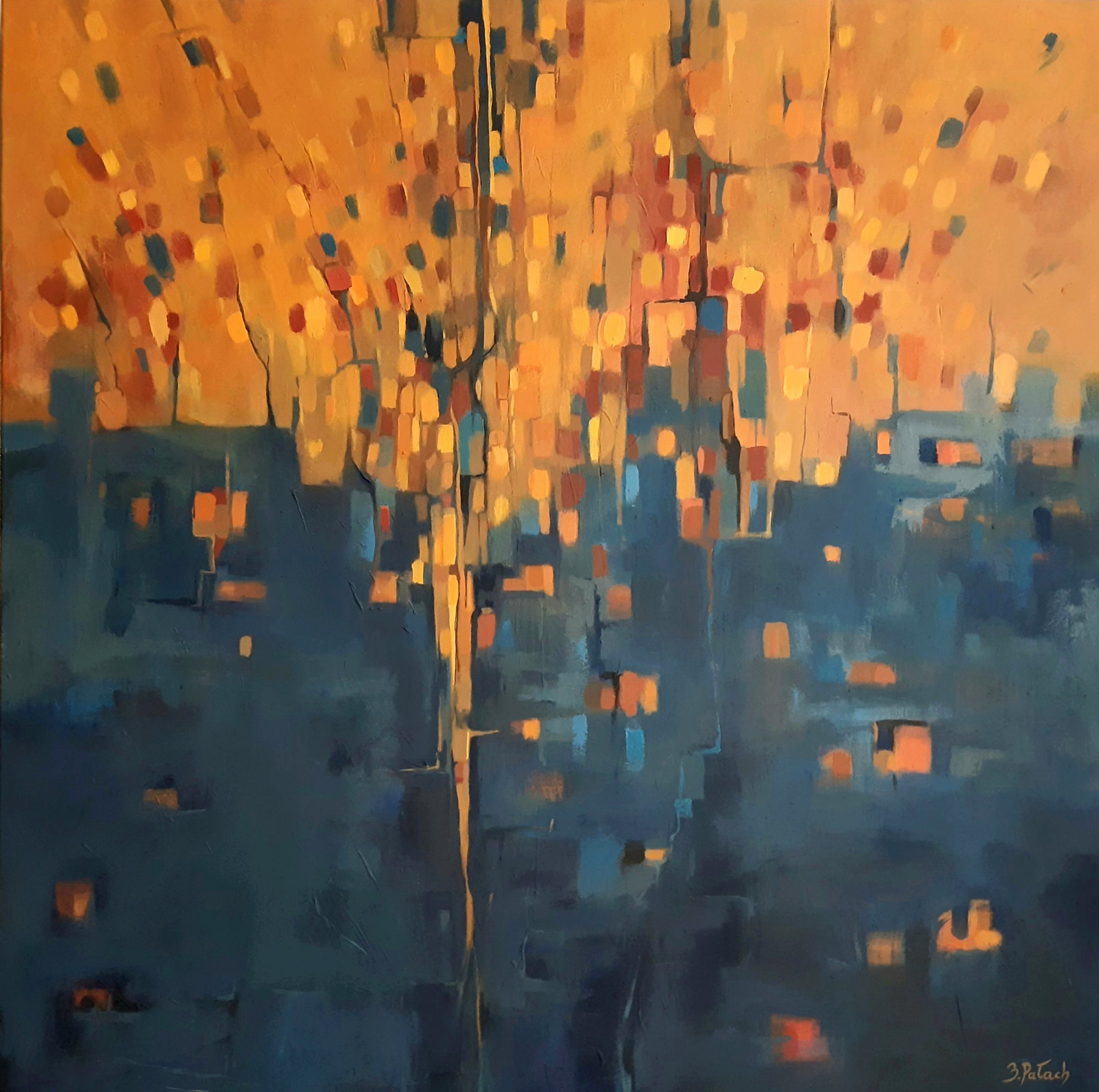
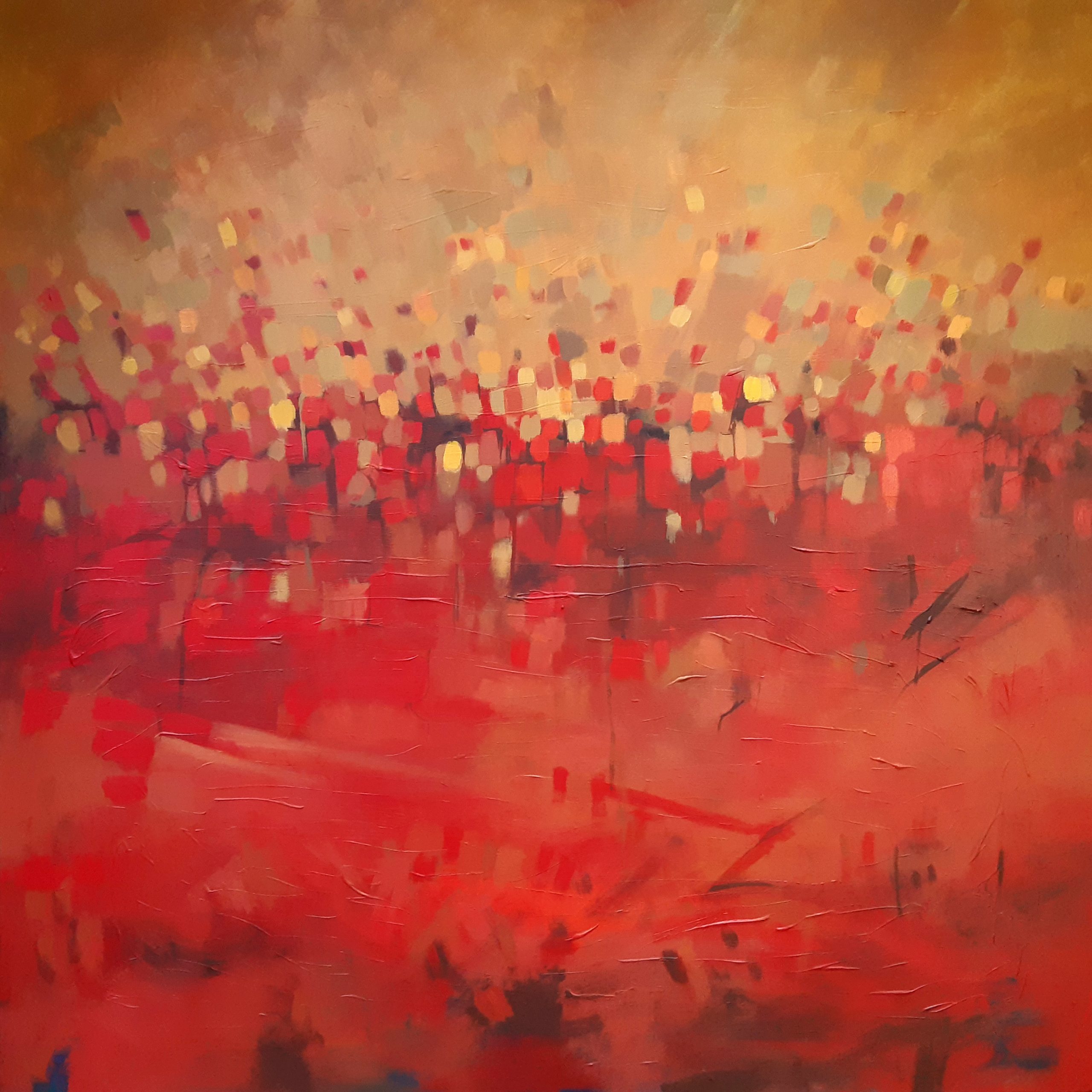
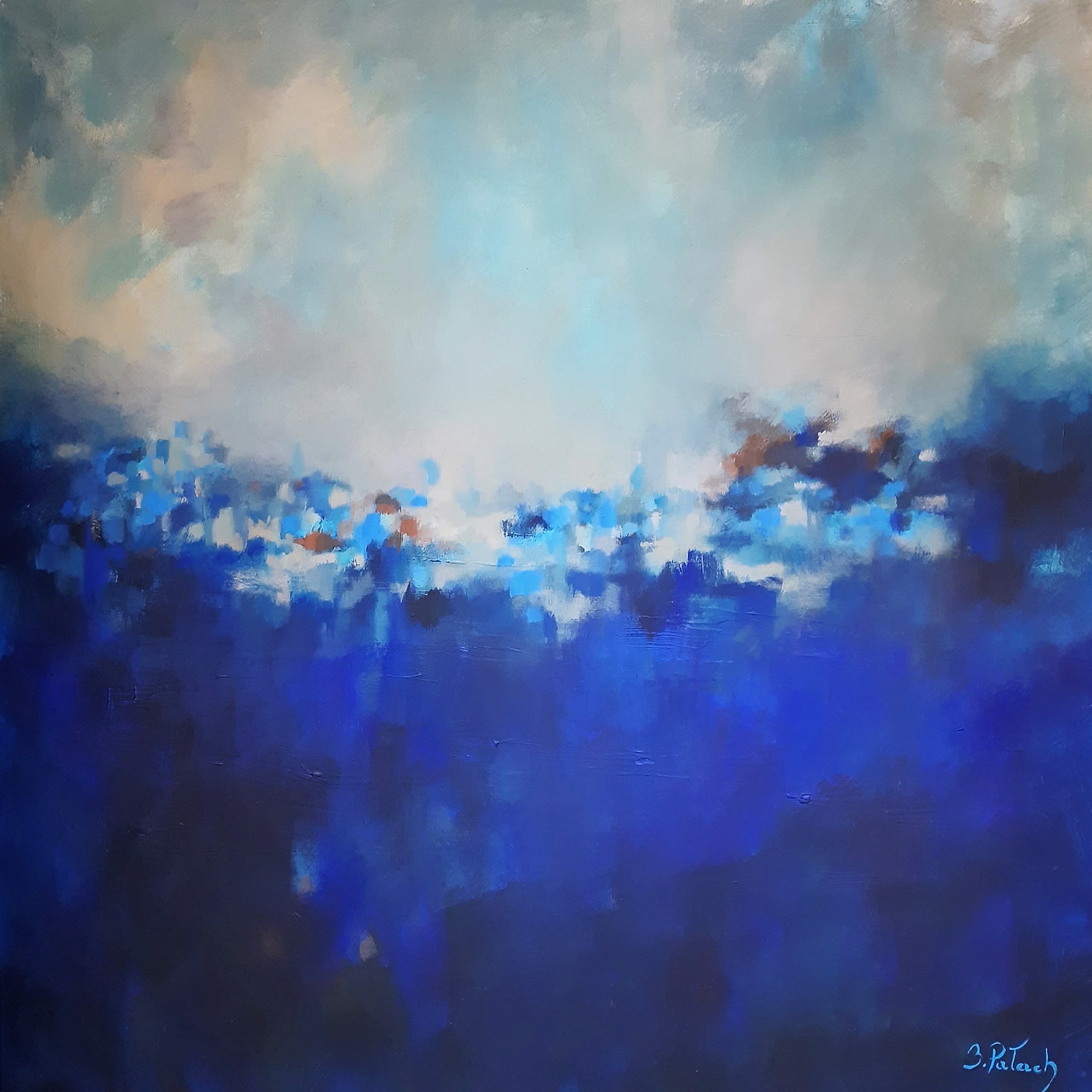
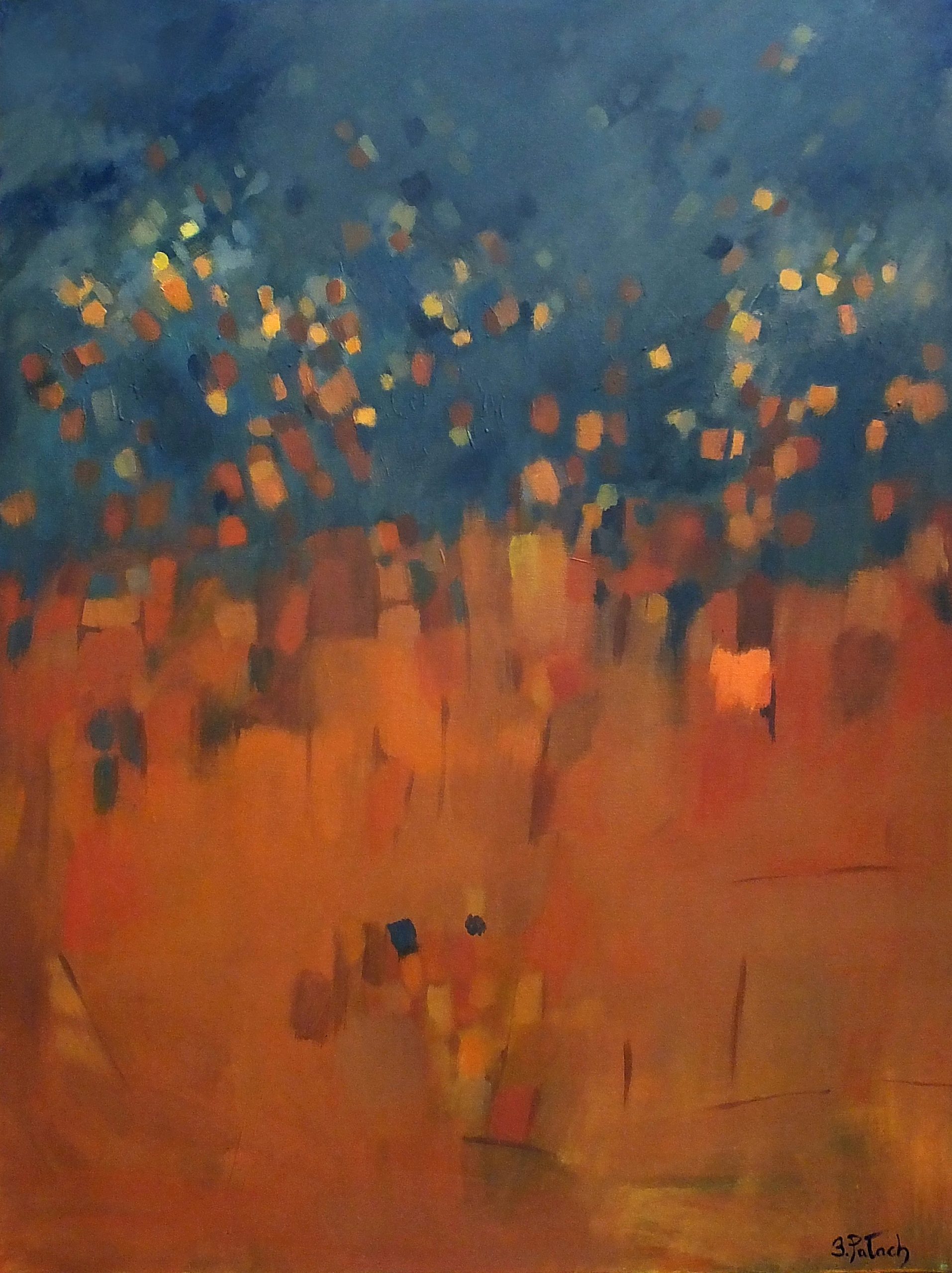
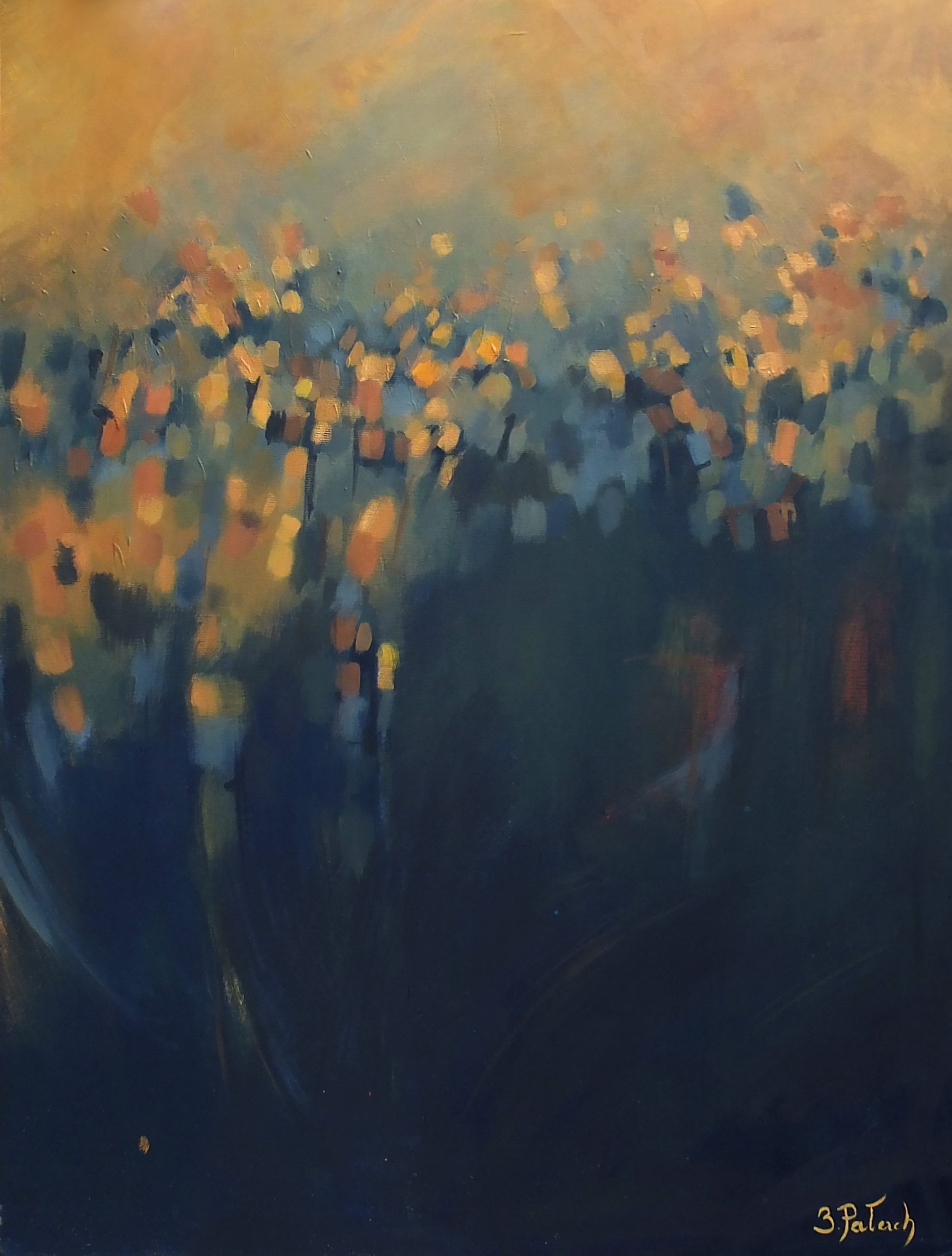
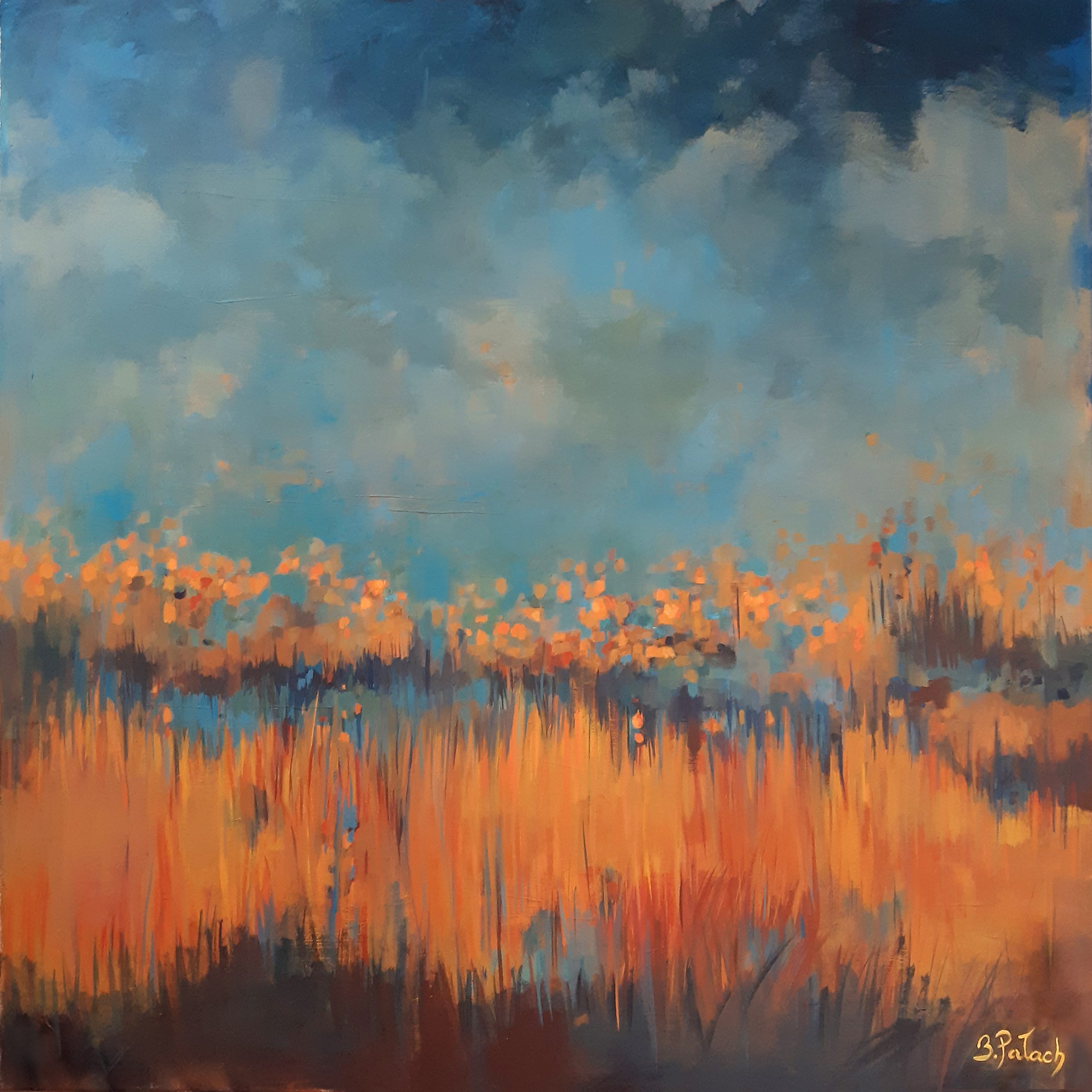

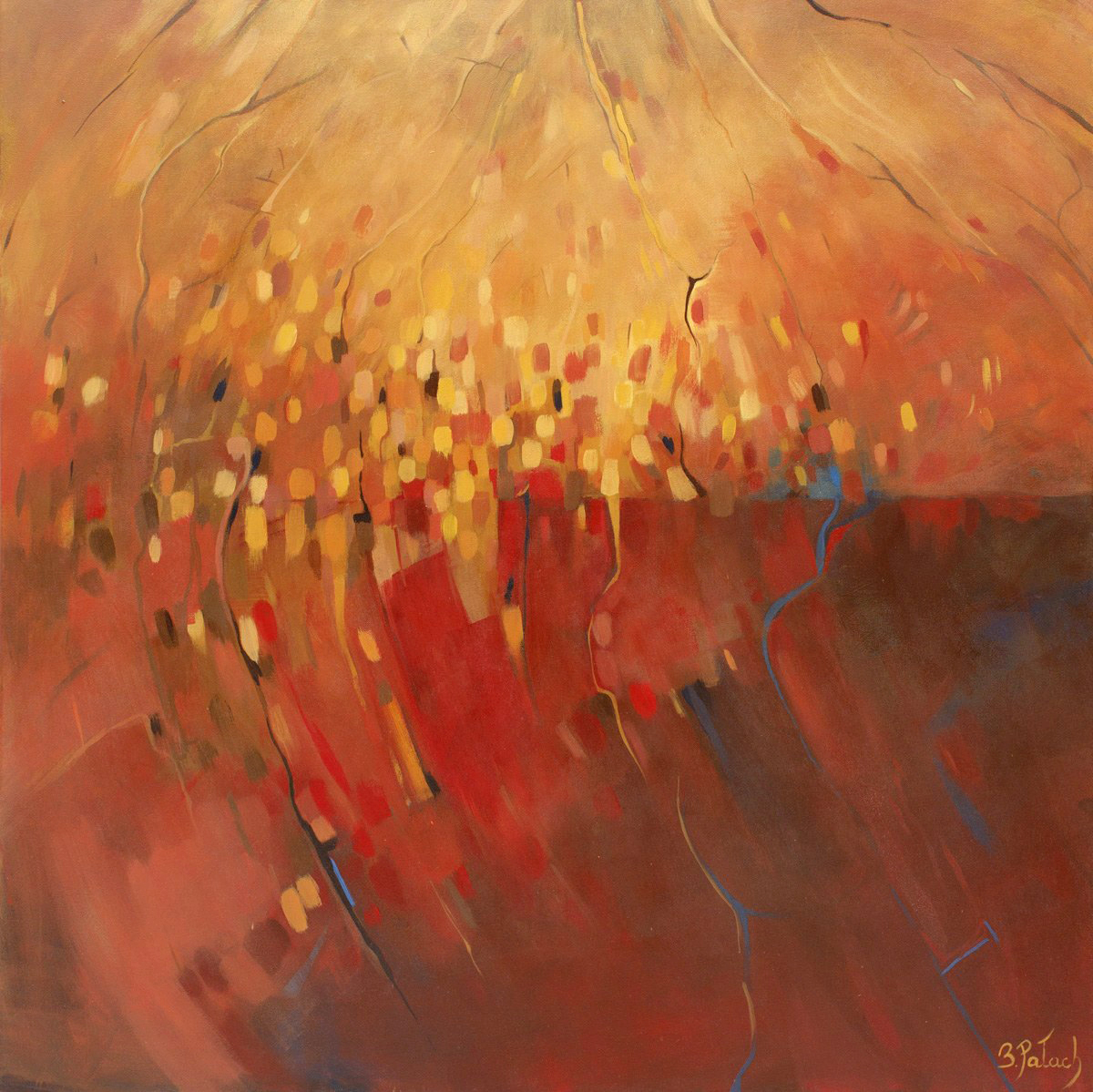
For obvious reasons, 2020 will go down in history. In addition to the pandemic and the related crises, Polish society also struggled with the growing problem of polarization. Provoked, instigated or even humiliated by politicians, increasingly frustrated social groups began to manifest their anger and helplessness by taking to the streets. The tension was at its peak. Artists from various fields have responded to this situation in two ways. Some actively engaged their creativity in protests or – depending on the faction – retaliatory actions. Others fled to the asylum of art and, hiding from the roaring, overwhelming world, seemed to ignore the omnipresent crisis.
Standing at the crossroads of two extreme needs, i.e. a sense of duty and commitment, and at the same time an instinctive desire for escapism, I decided to transfer this experience to a canvas. As a result of this dualism, I created a series of abstract paintings that express both formal and philosophical searches. Contrasting colour compositions, an expressive gesture, dynamic quivering spots – all this, combined with allusive titles, is a record of my internal experiences and reflections. When there are arguments and scuffles at rallies, and pompous slogans and calls to hatred are shouted, all in the name of patriotism and love of the motherland, I ask myself: what exactly is the motherland? For me, it is a meadow strewn with various herbs, pulsating with flying insects. It is a dynamically changing sky with billowing clouds. It is a forest concert of birds and a light spectacle when the sun breaks through twitching branches and dancing leaves … What do these two Polands have in common? Maybe the same intensity of emotions and passions? Maybe similar energy and strength? This obstinacy to persists regardless of time and circumstances. Finally, diversity and colourfulness – Isn’t this what makes this world powerful and beautiful?
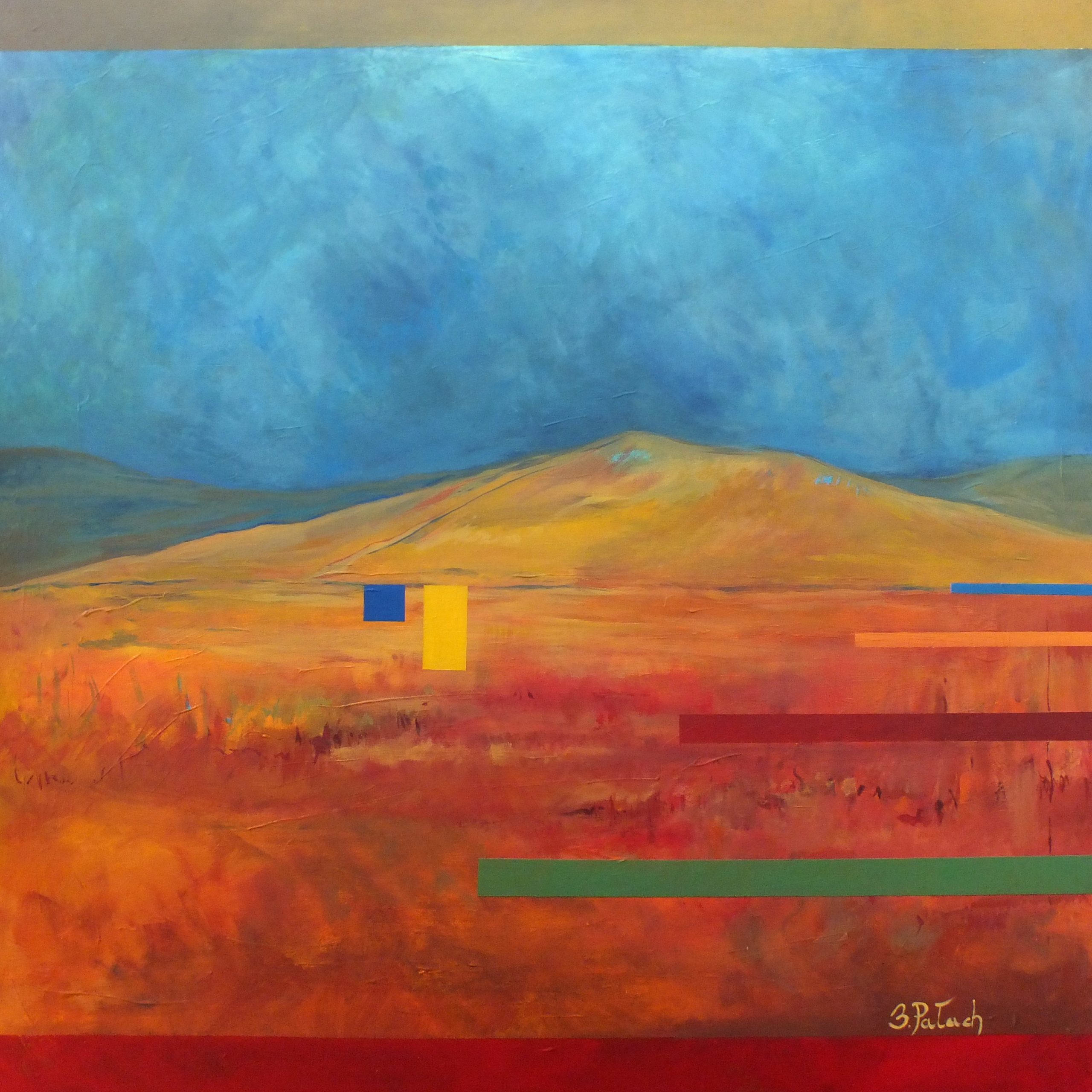
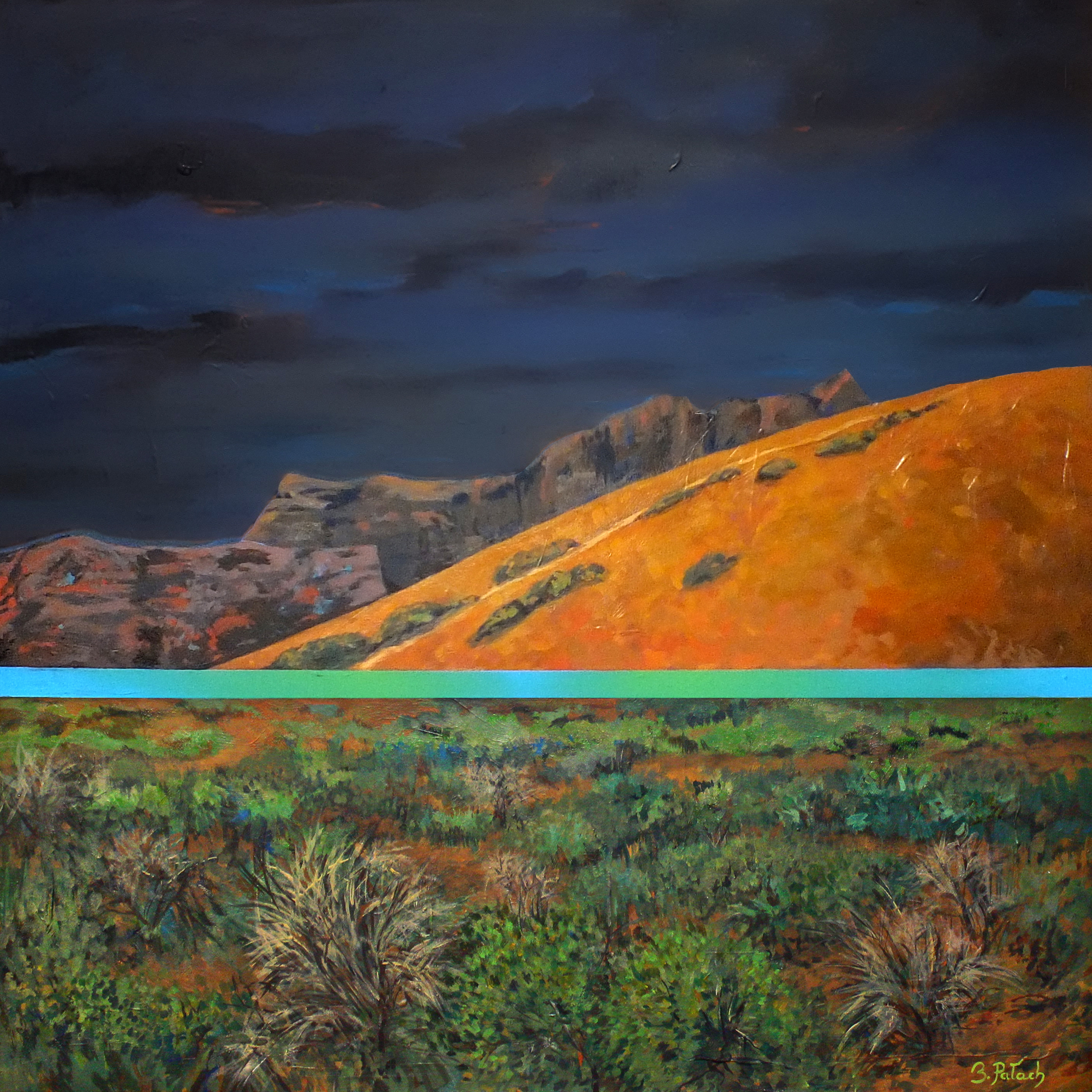
The “Anthropogenic Landscapes” series was created in 2020 as a commentary on the effects of human activities and their impact on the Earth. At first glance these are typical landscapes: a picture of a hill, sea horizon, random ruins or skyline of a city. But there’s a disturbing emptiness emanating from all of these paintings – the lack of living beings. You will not find even a bird’s shadow floating on the sky.
However there are some traces of human presence: flat polygons, straight, parallel stripes, often in intense, vivid colours. Like printing errors, blurred areas of censorship, or scattered screen pixels – these objects seem like a foreign body in a harmoniously functioning organism. Shapes like that do not occur naturally in the environment, so they evoke an obvious association with a human being… or one could say, “a ruling being” usurping everything that stands at their way.
As an excuse to progress and discover these beings make transformations that are inexplicable to other inhabitants of the Earth, interfering with their world by creating mysterious and illogical obstacles. Where are these activities leading? Will the landscape, seen through the eyes of another creator, keep vanishing and plunging into emptiness until it gets covered by a blurred rectangle?
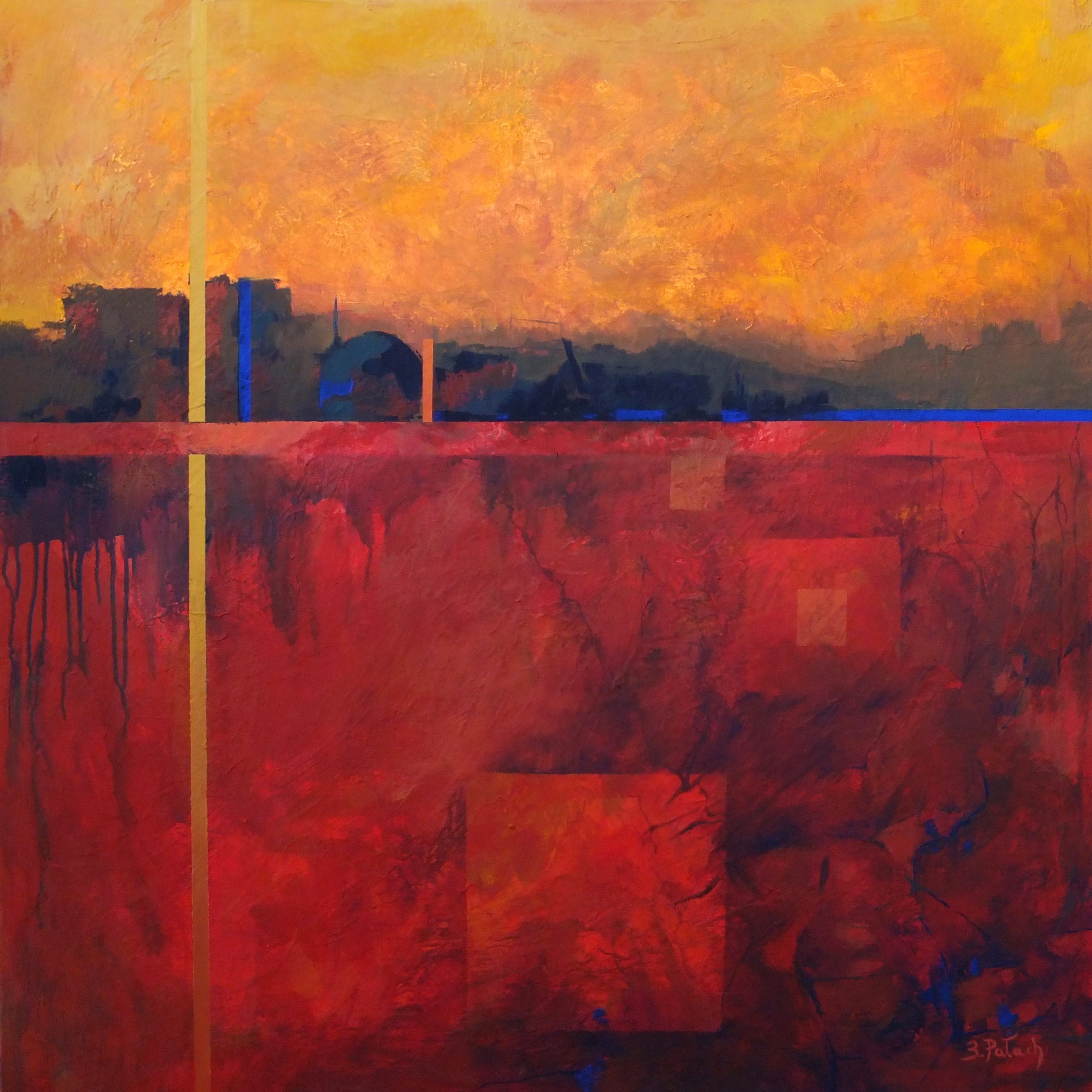
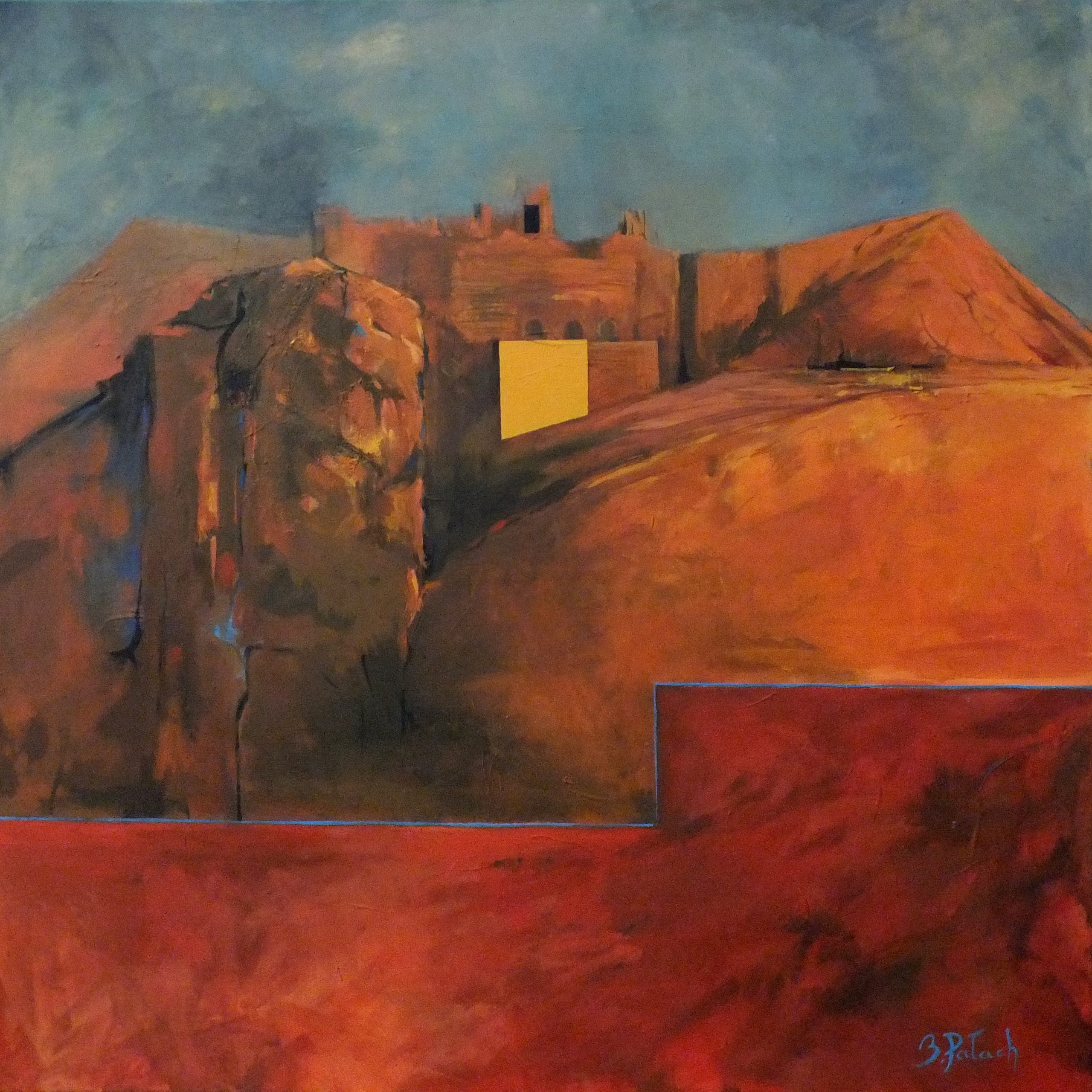

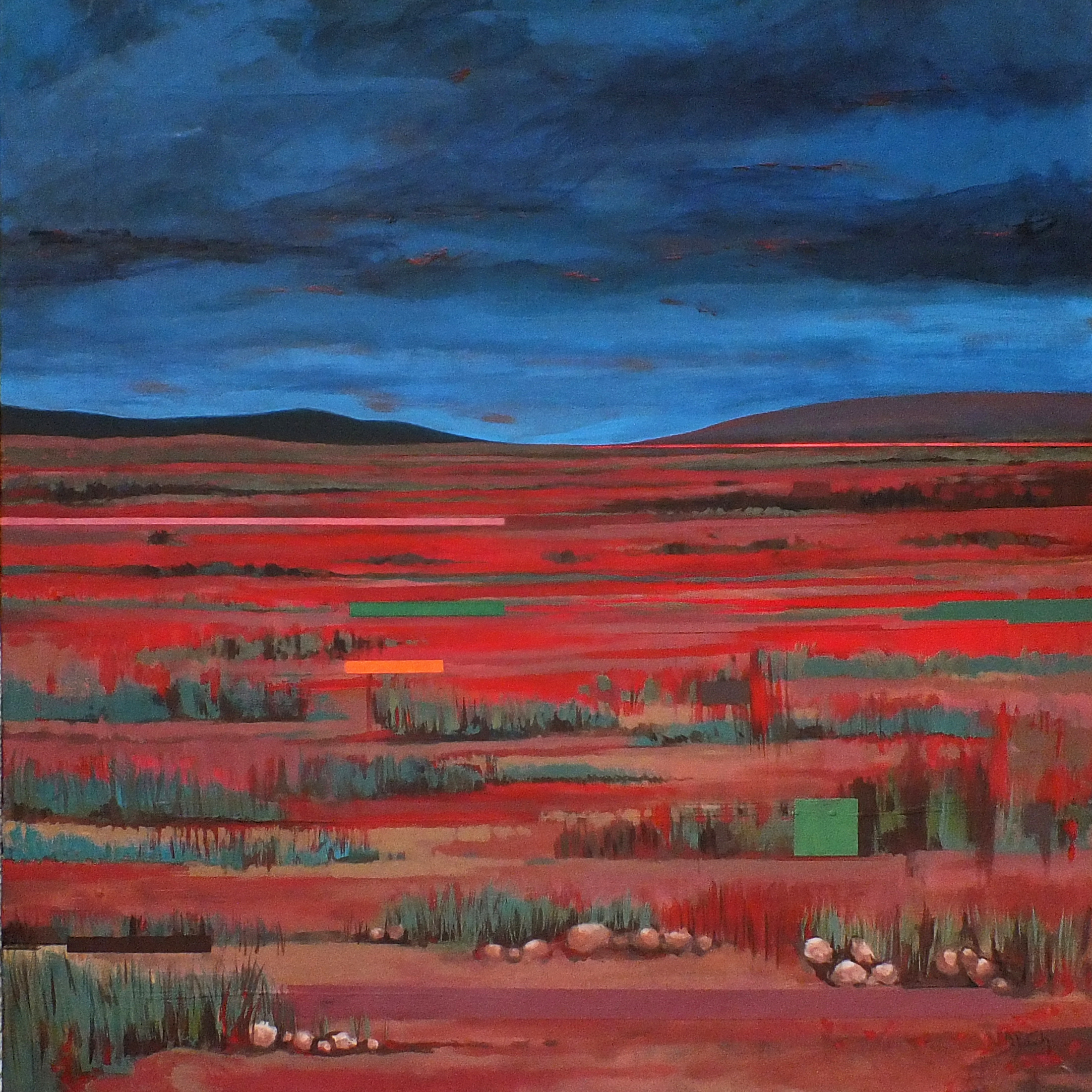
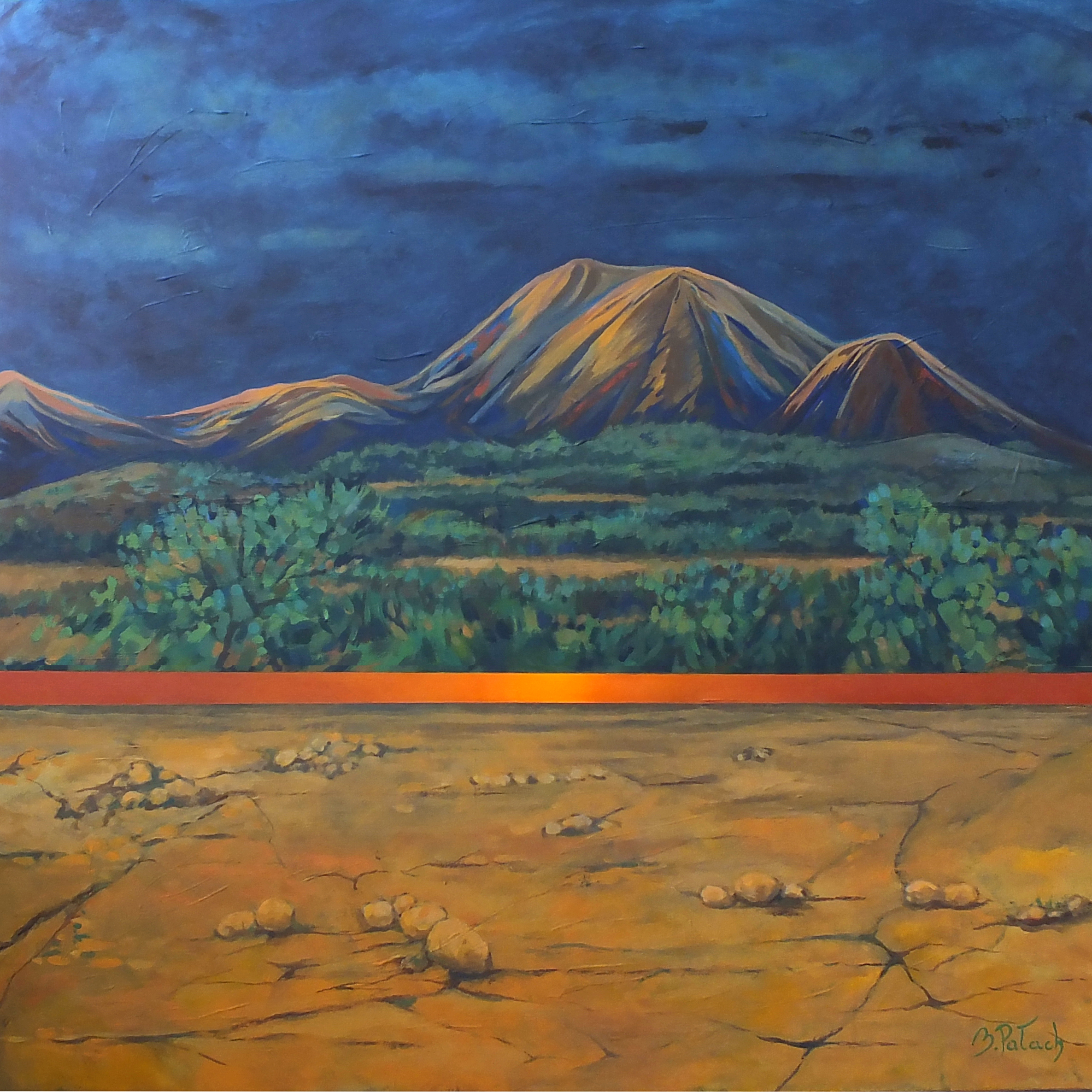
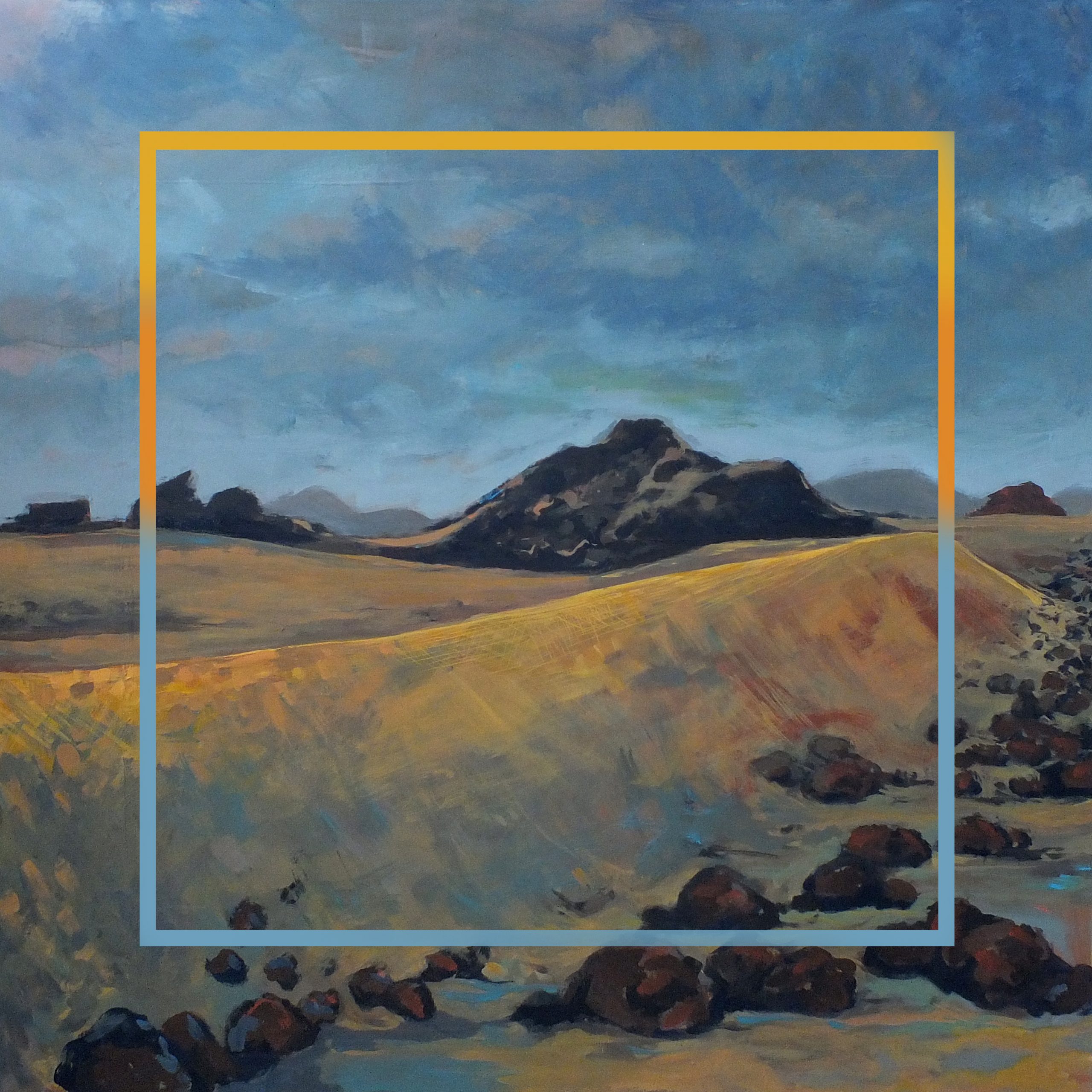

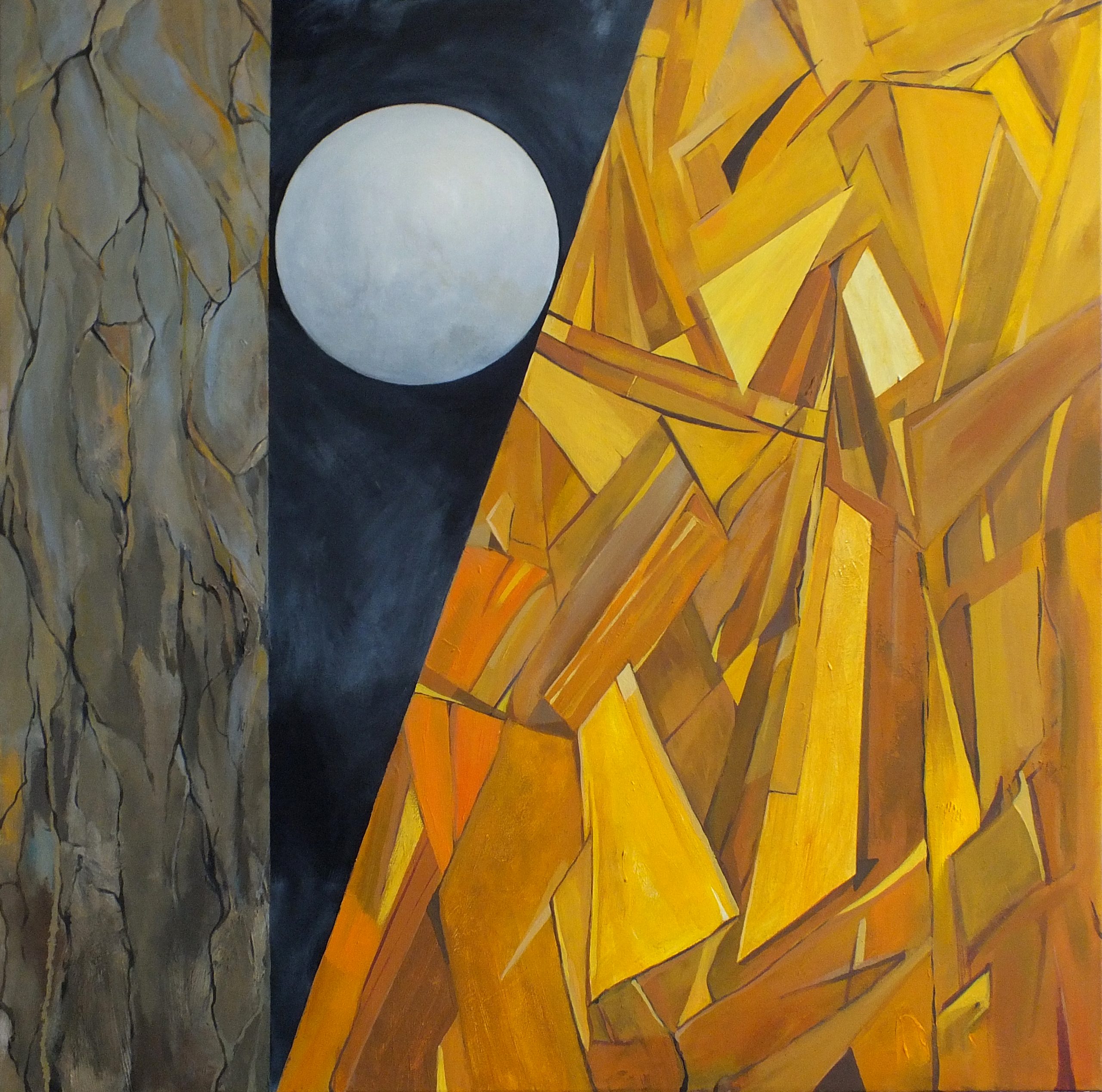
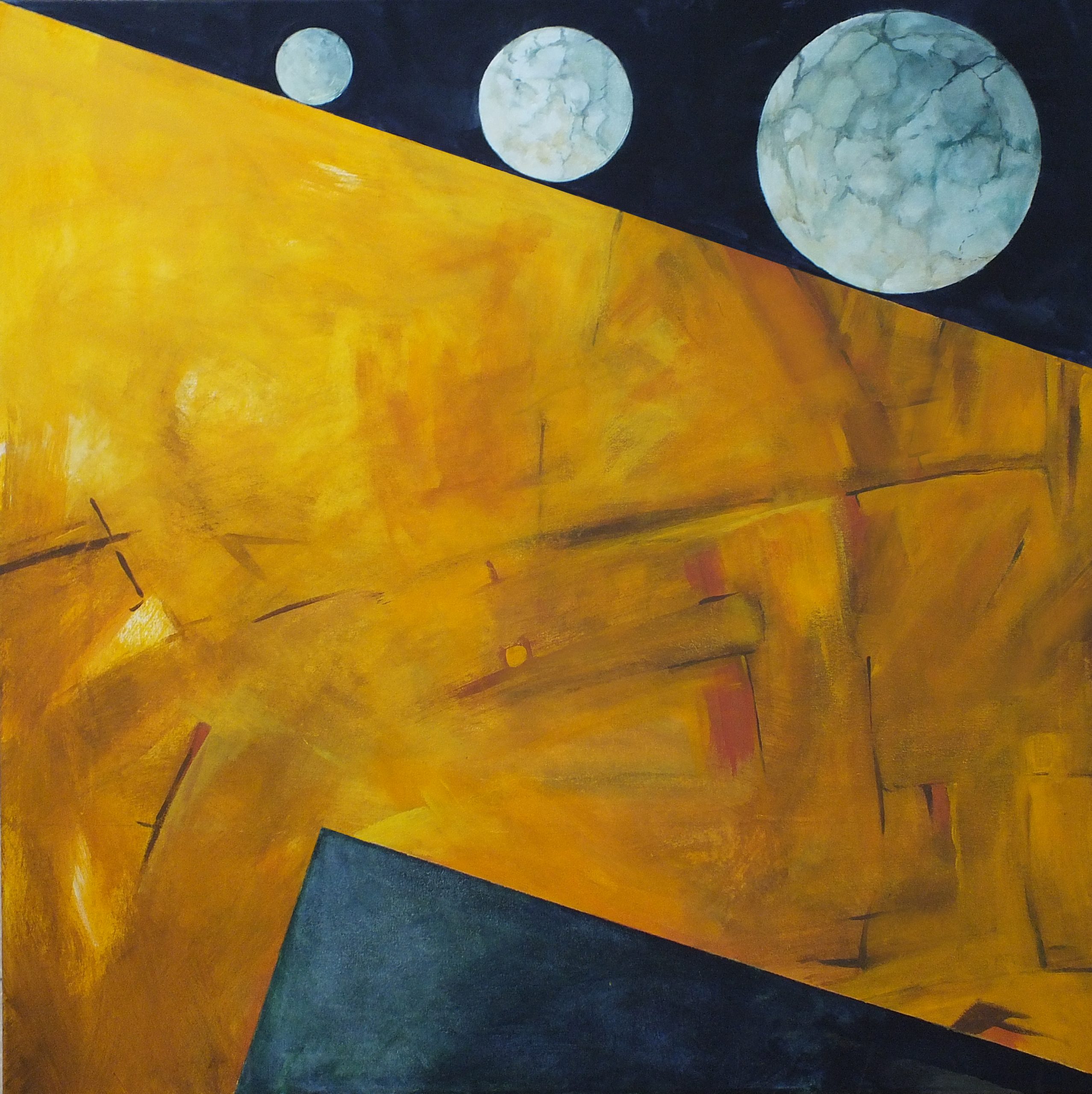
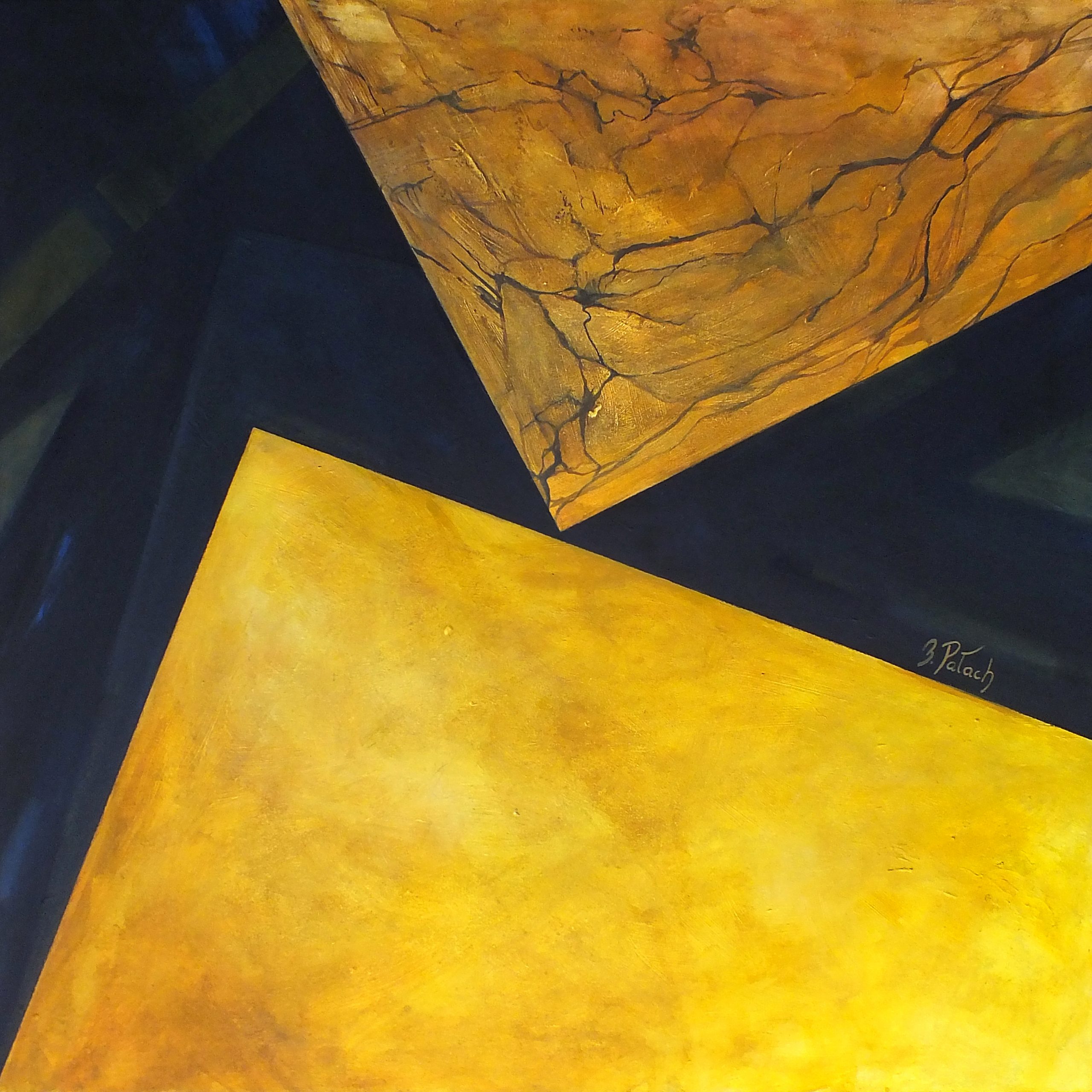
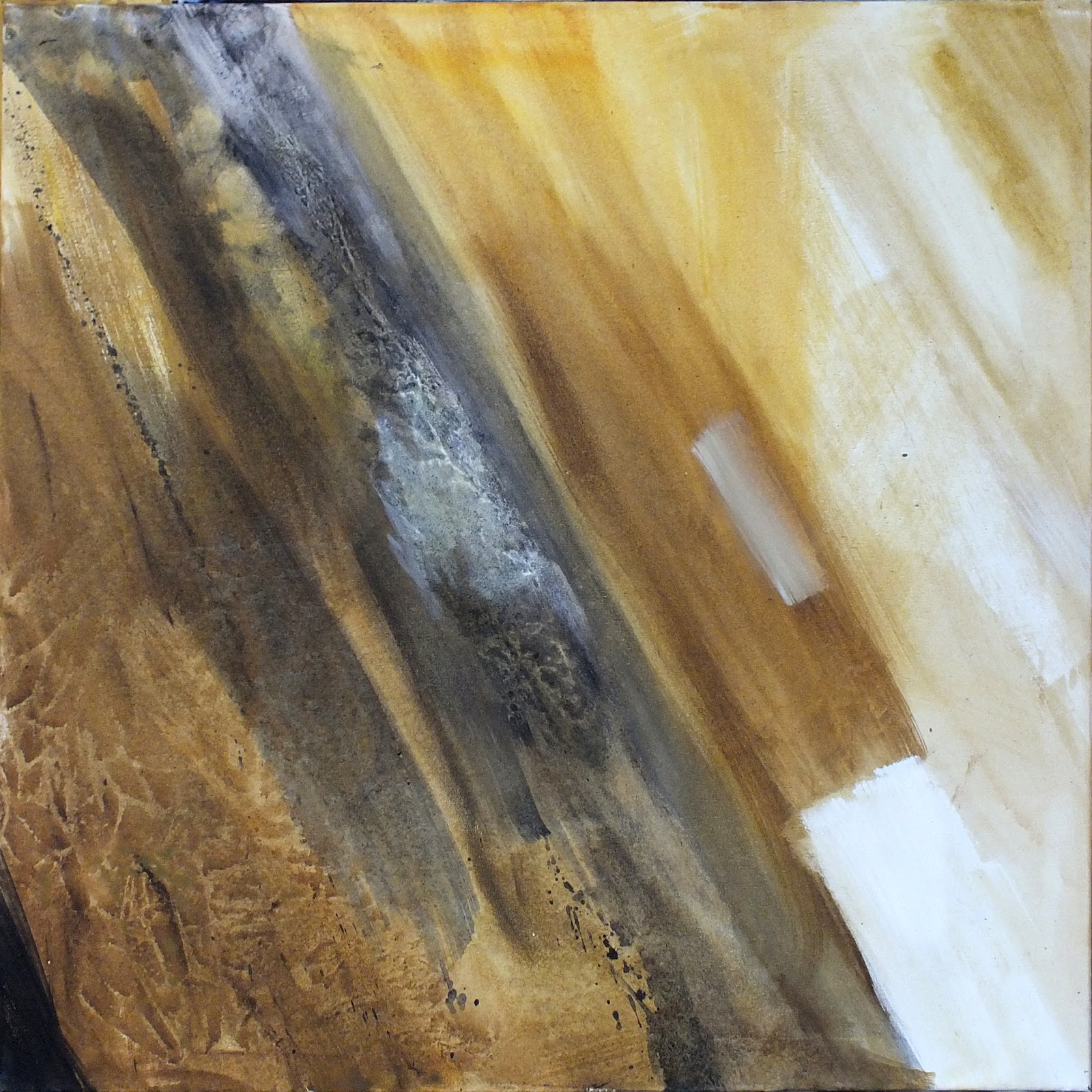
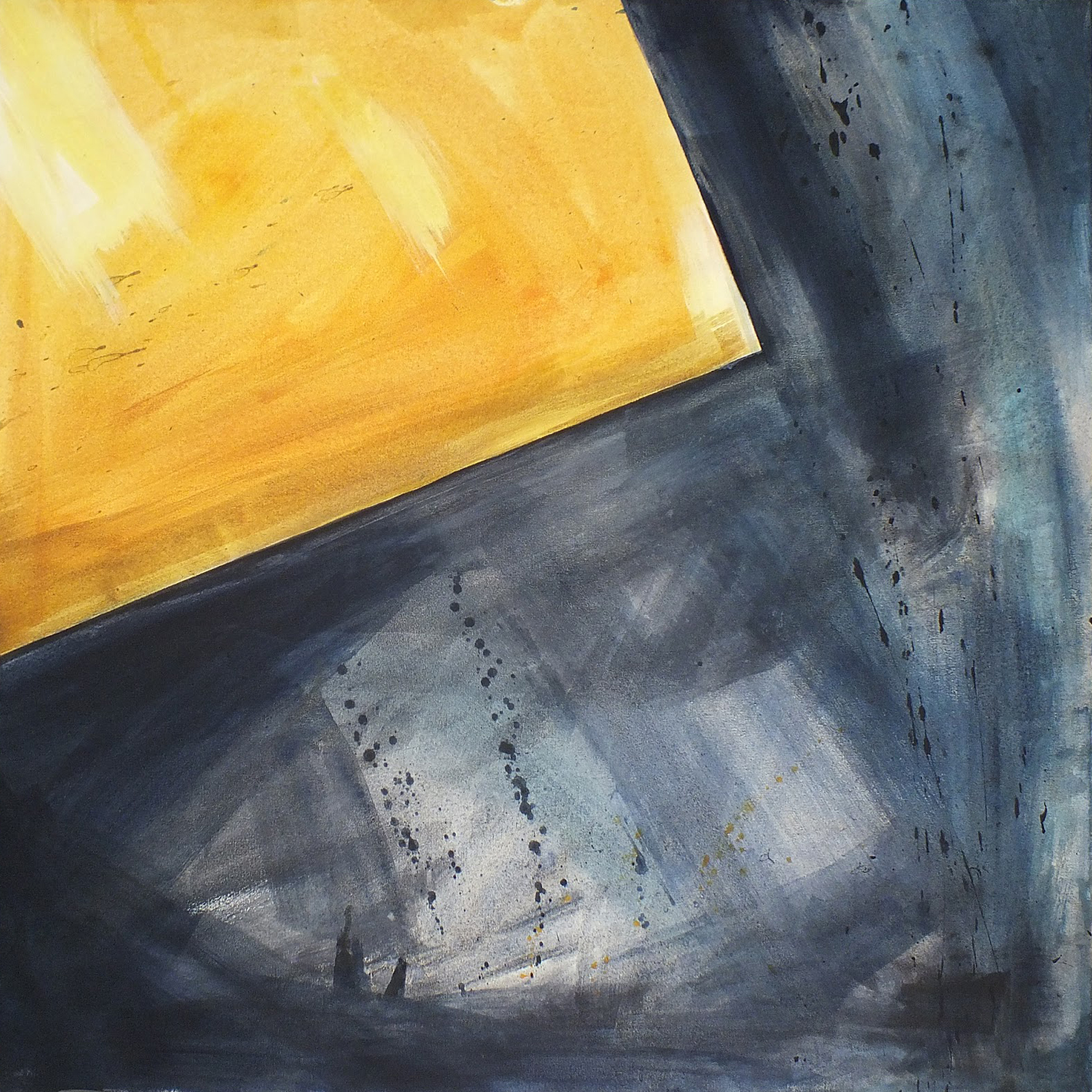
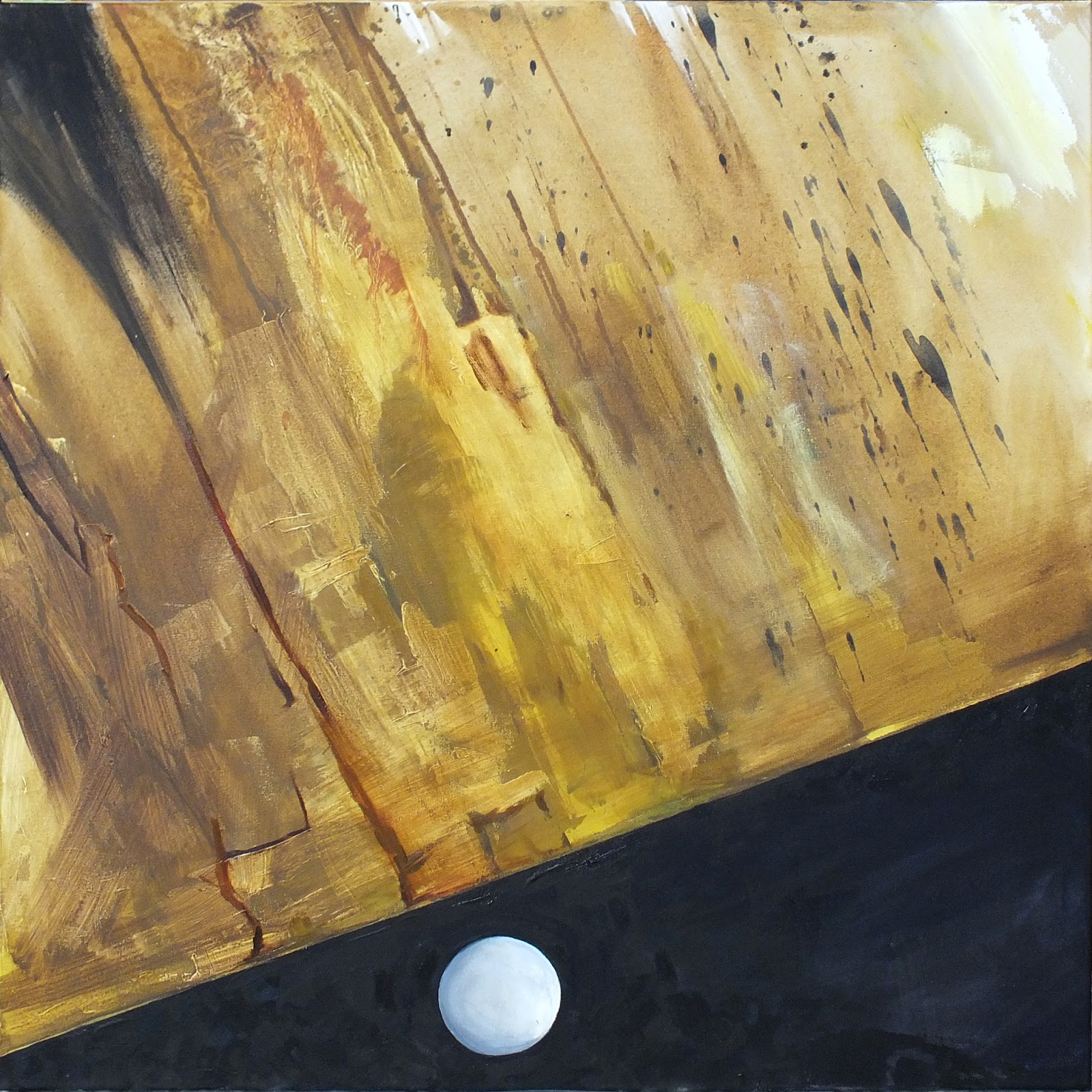
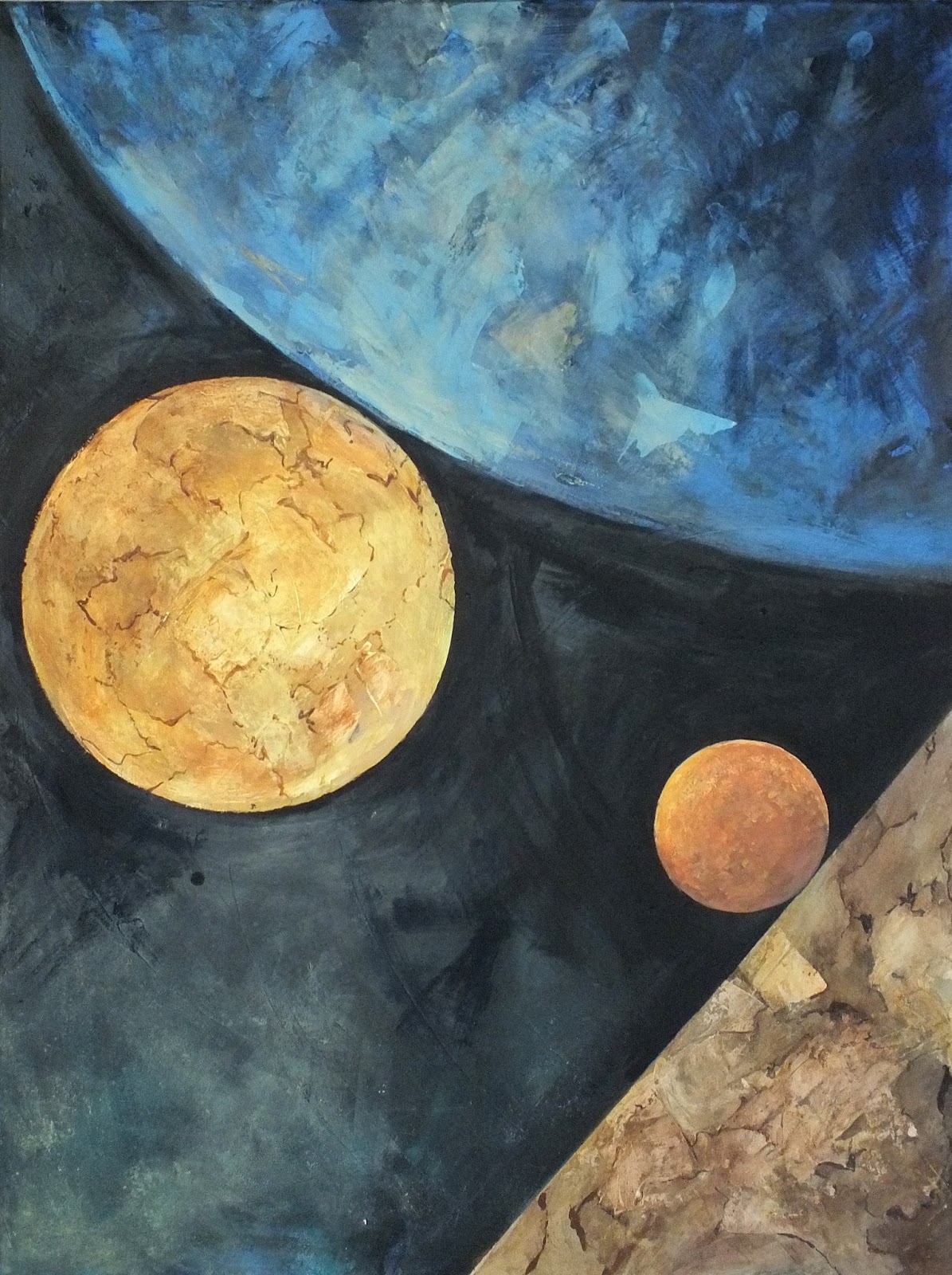
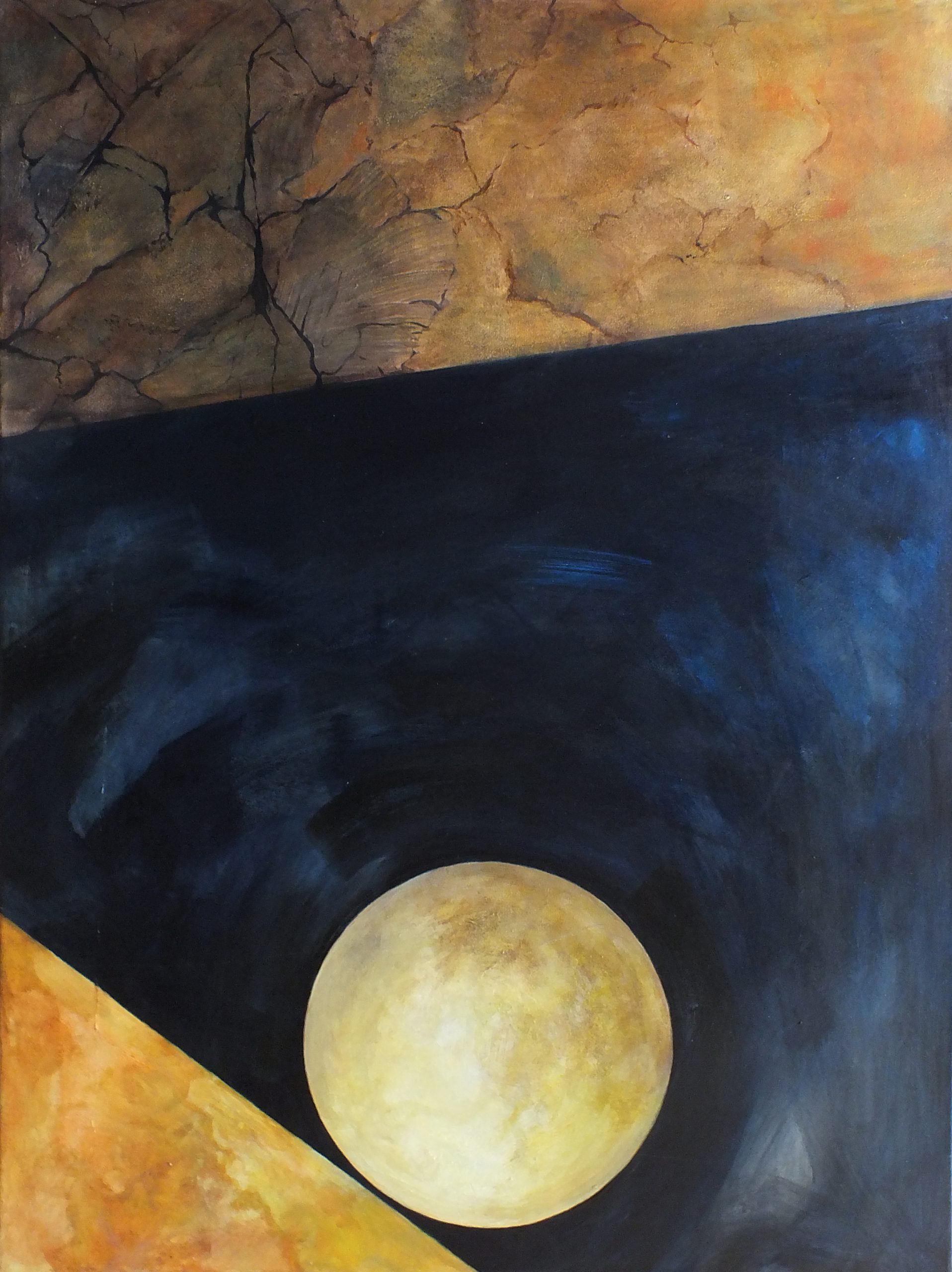
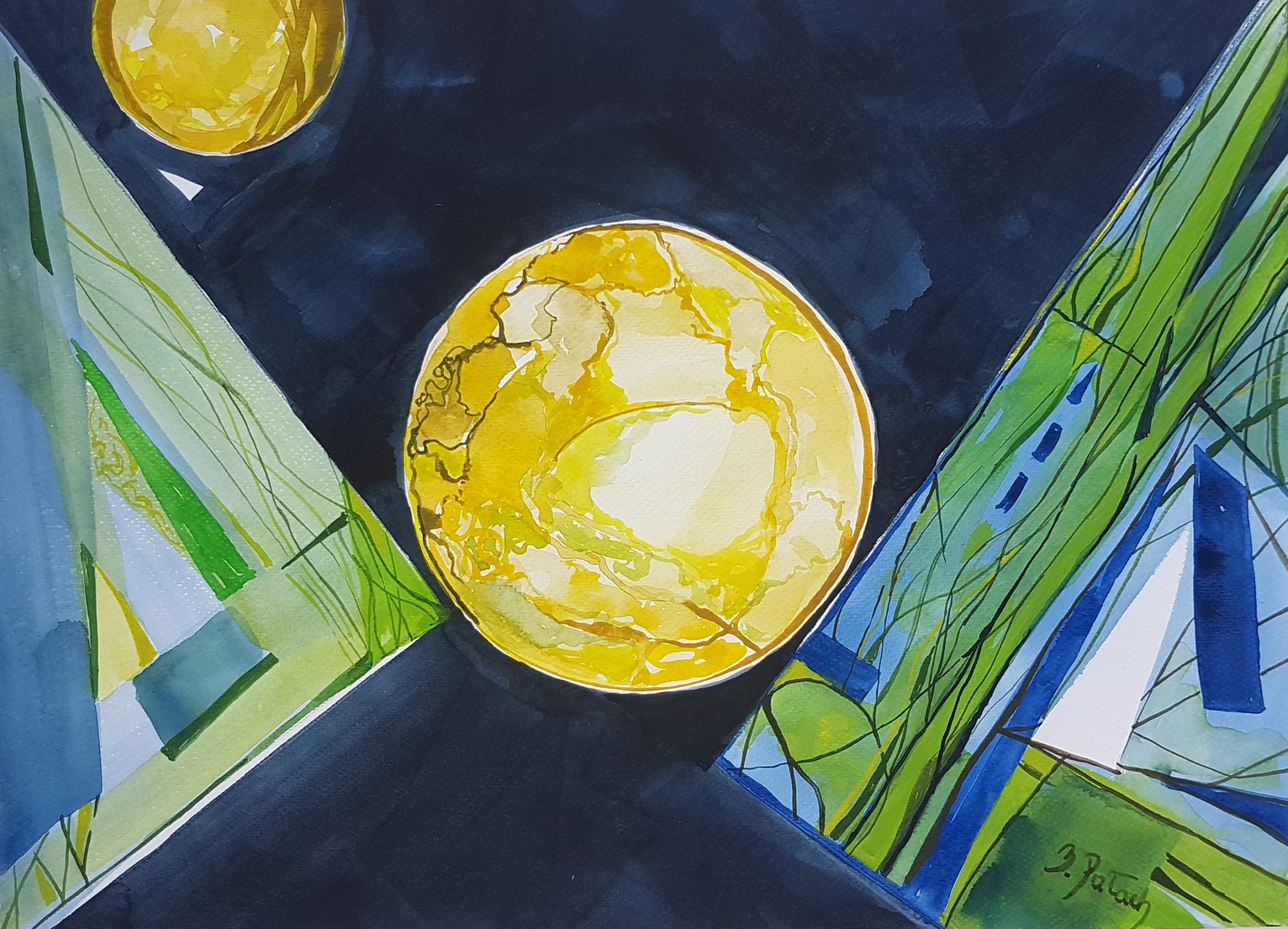
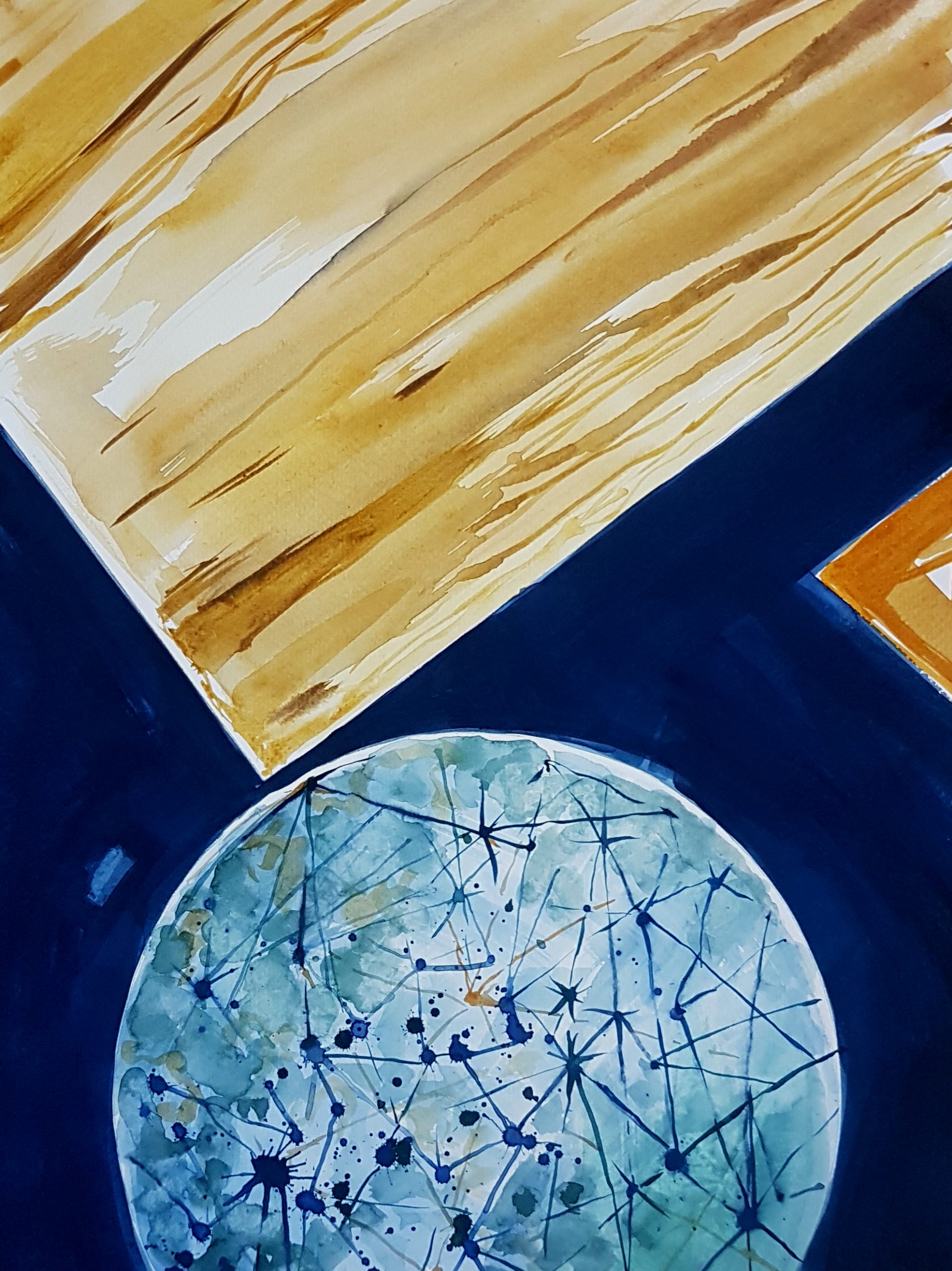
The Gravity series consists of paintings on canvas presented as polyptychs. Each image is composed in a way to perfectly match another image from this collection. Paintings can be freely rotated and arranged in various ways, always creating a coherent whole. Individually, each work can be an independent abstract image, but in combination with subsequent images, these fragments take on a different shape and meaning, changing our point of view.
The paintings of this series are often built in a diagonal, open composition, filled with colors of sand and the night sky. This is to symbolize the collision of two worlds: terrestrial and cosmic. What keeps this mysterious chaos working? For centuries, humans have been trying to answer this question, creating gods, inventing legends, exploring the secrets of science … Like some parts of a polyptych, we divide the fragments of reality and try to arrange them in an understandable order. But will we ever be given a final knowledge of this secret?
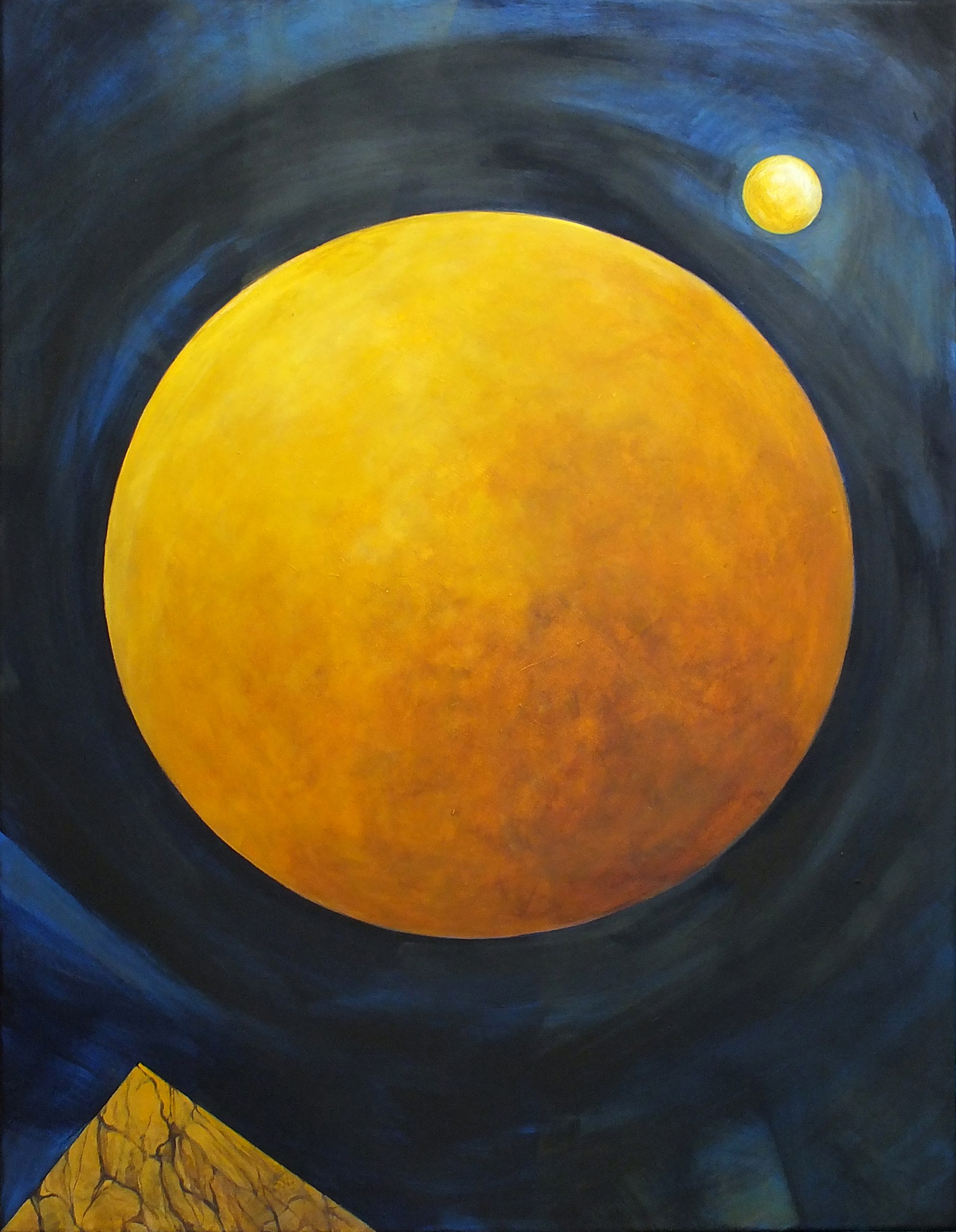
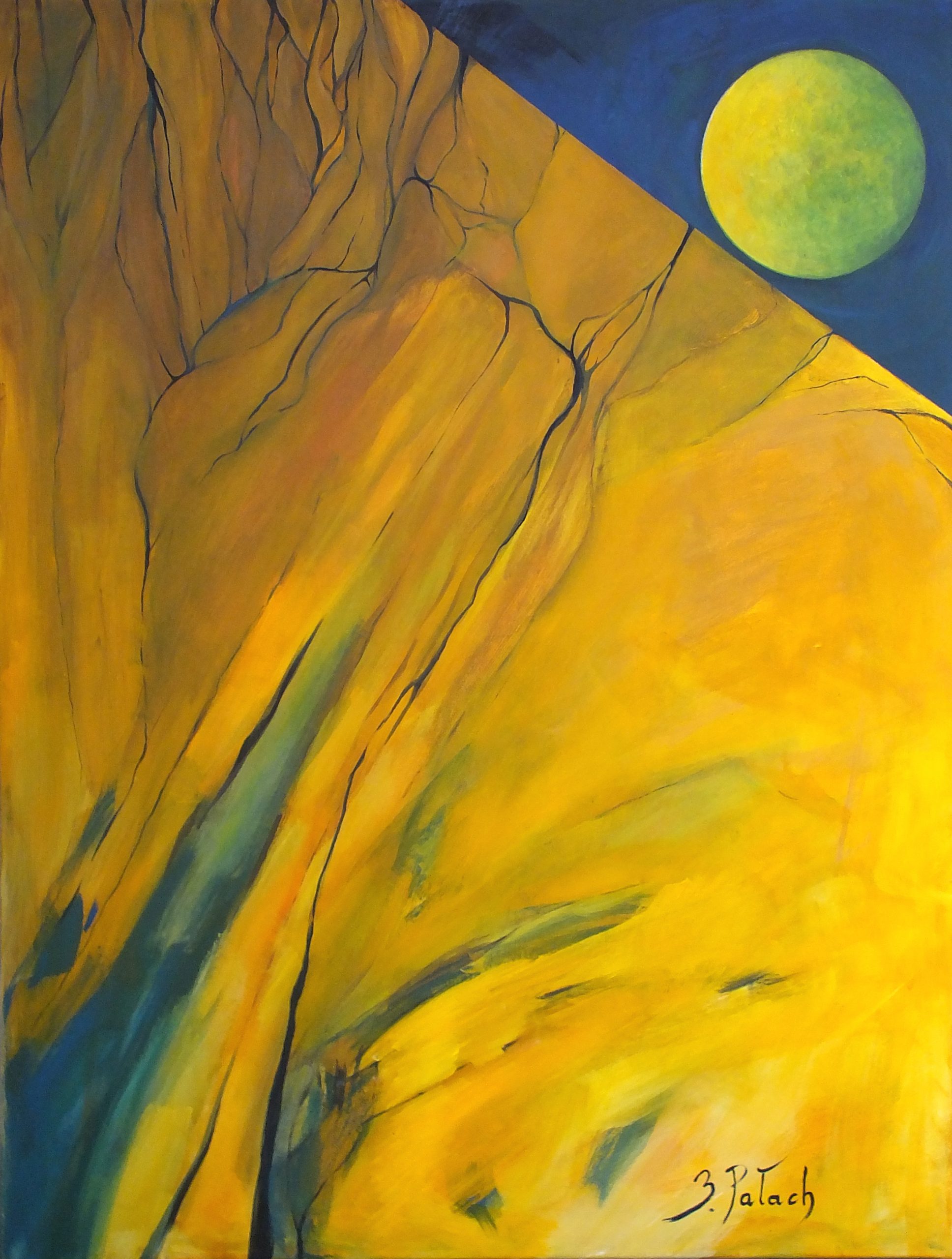
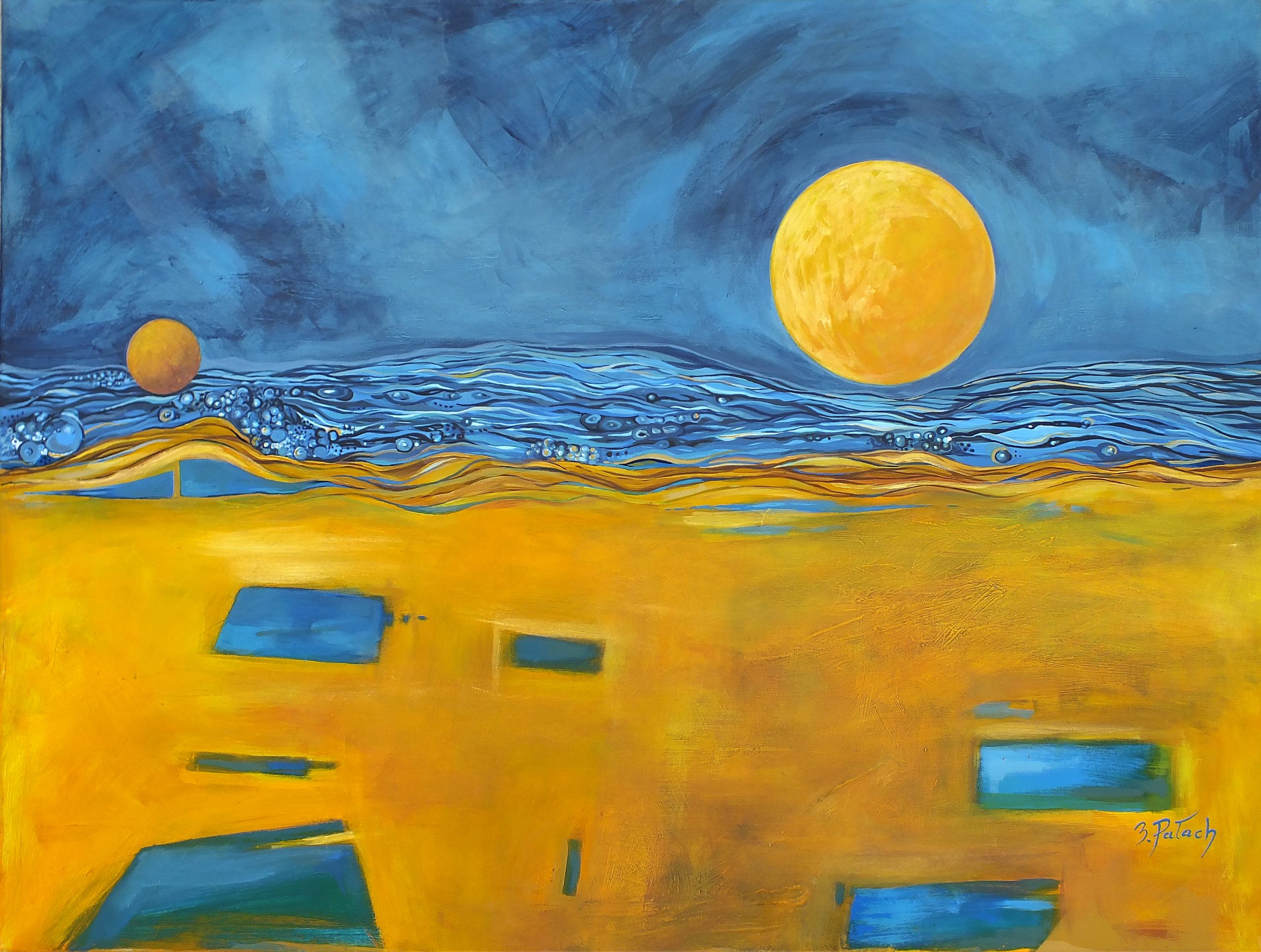
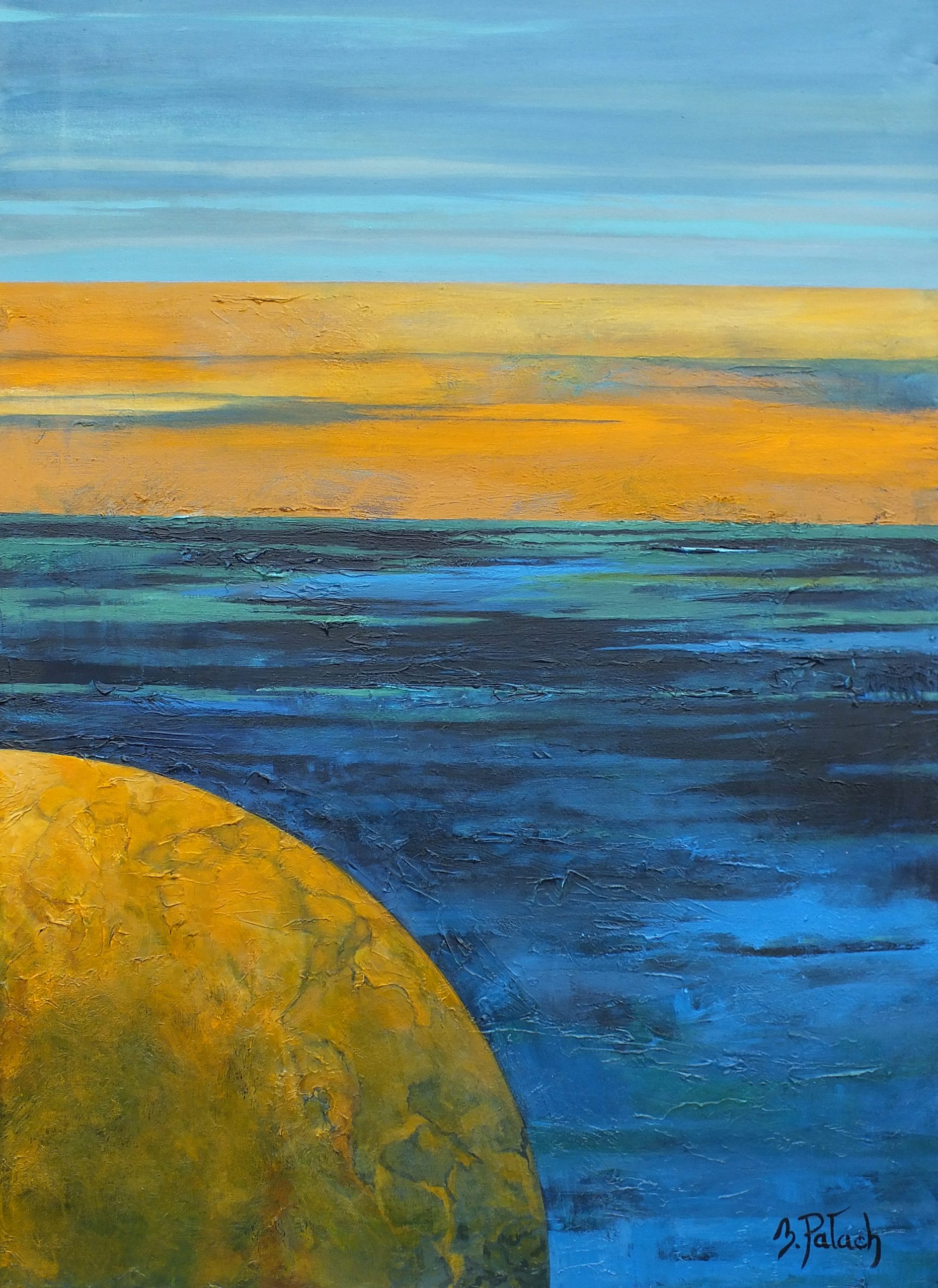
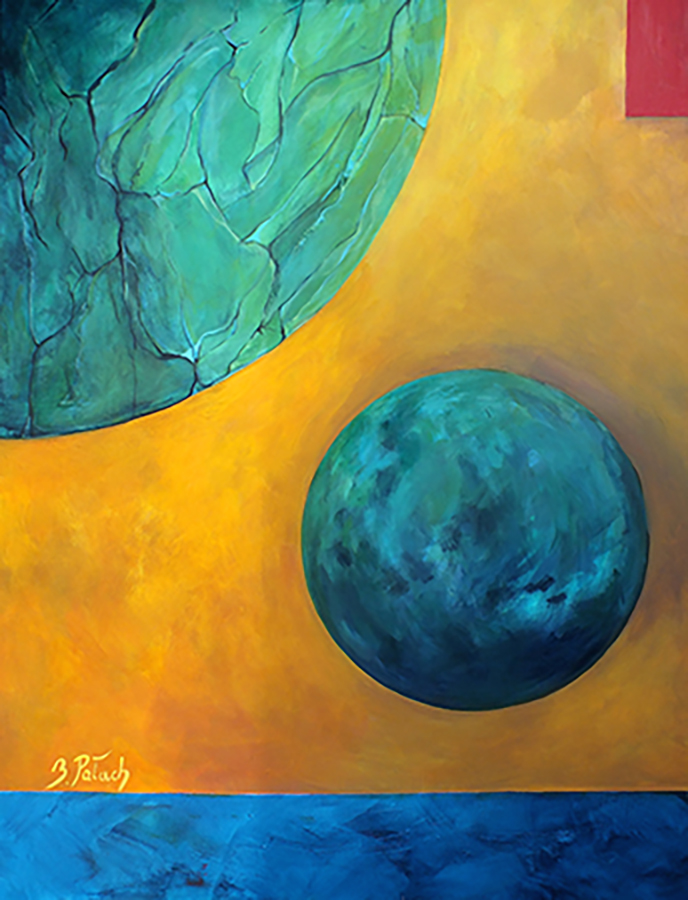


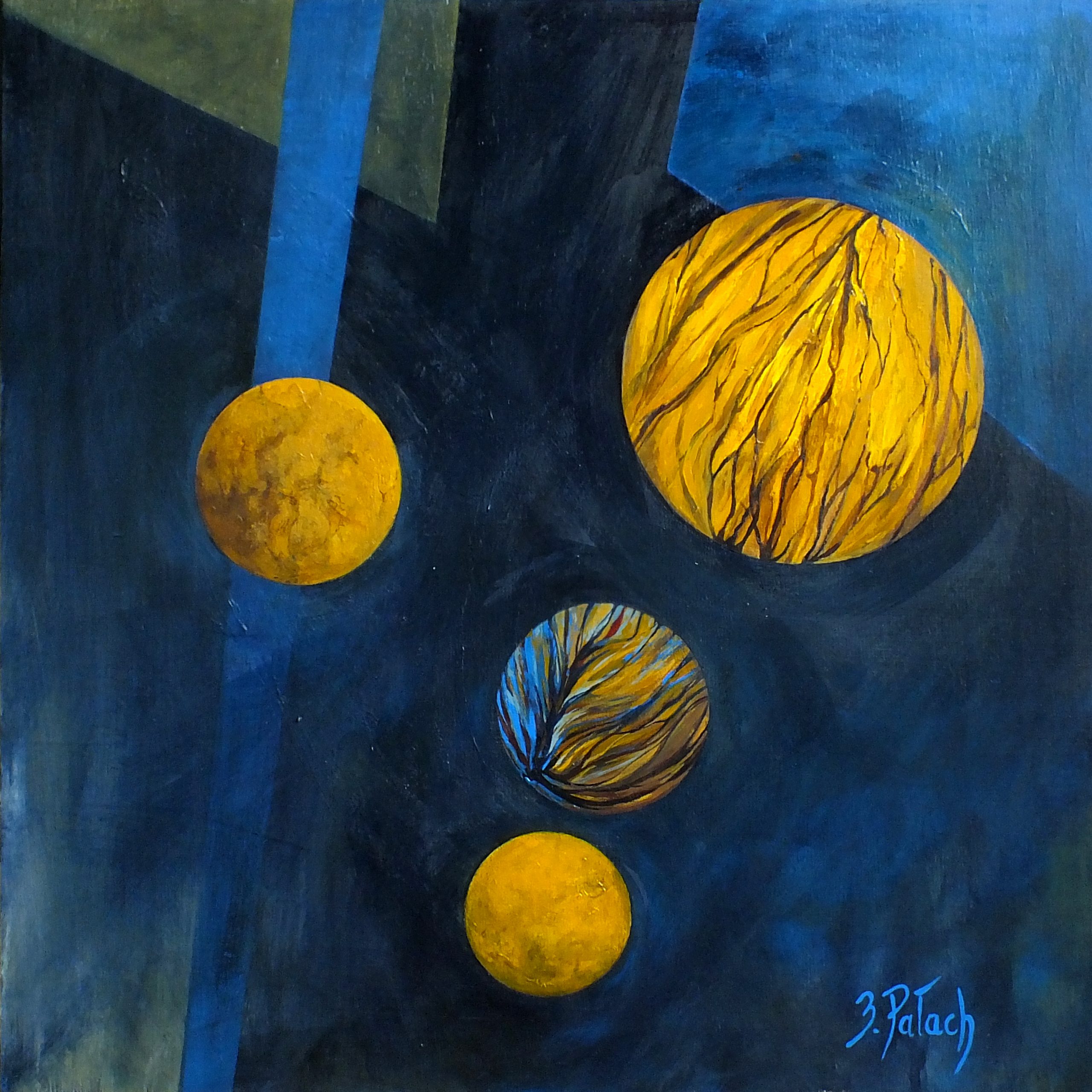



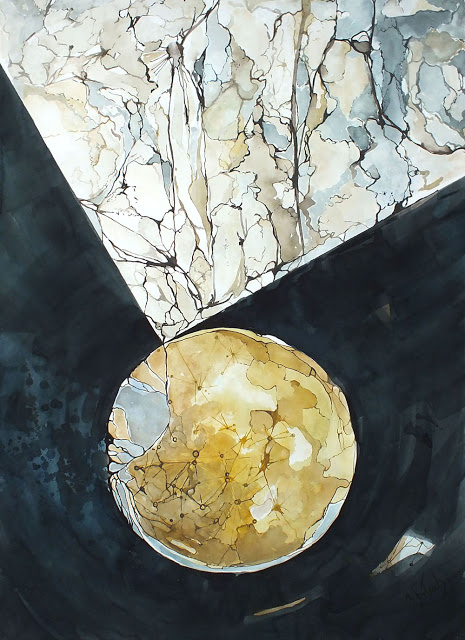
The series “Universe” consists of watercolour paintings on paper created in 2015-2019.
Beata Pałach doesn’t try to copy nighter recreate any cosmic motives. She rather introduces her own objects, intriguing abstract shapes, some mosaics of undefined form: melted crystals, tides, whirls, frozen in motion, sharply framed circles, which as a whole are quite static and balanced. Her paintings aren’t overloaded with details. Based on strong chromatic dissonances – in which the honey-purple elements contrast with the inky streaks, and the malachite reflections melt into greenish-pearly shades of the background – her paintings are lined with elusive tension, a certain existential seriousness, and even some metaphysical anxiety.
One thing about abstract paintings is that they can be interpreted in various ways. So you have to carefully weigh the words and draw conclusions so as not to fall into the trap of overinterpretation. Perhaps the author wants to point out that we are simply impersonally stretched on two infinities- from the micro to the macrocosm. For me Beata’s paintings are a narrative tension and thus an intriguing vision of different worlds. Worlds on the edge, behind which stretches the abyss of an inaccessible mystery. Because there are still borders that, despite the progress of science and technology, have not been crossed so far. | Michał Baca
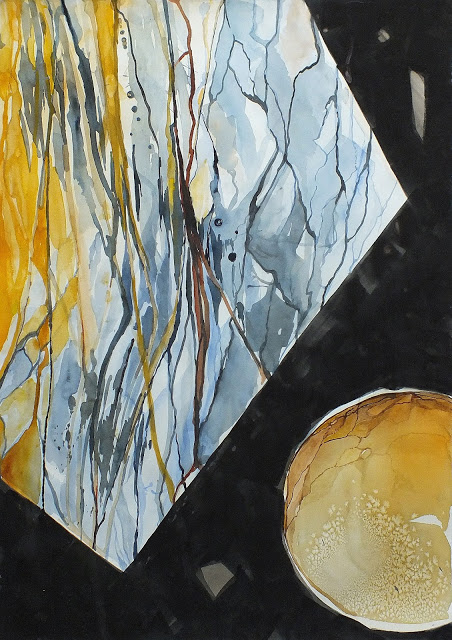
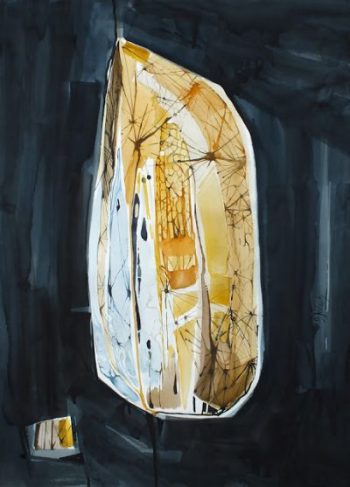
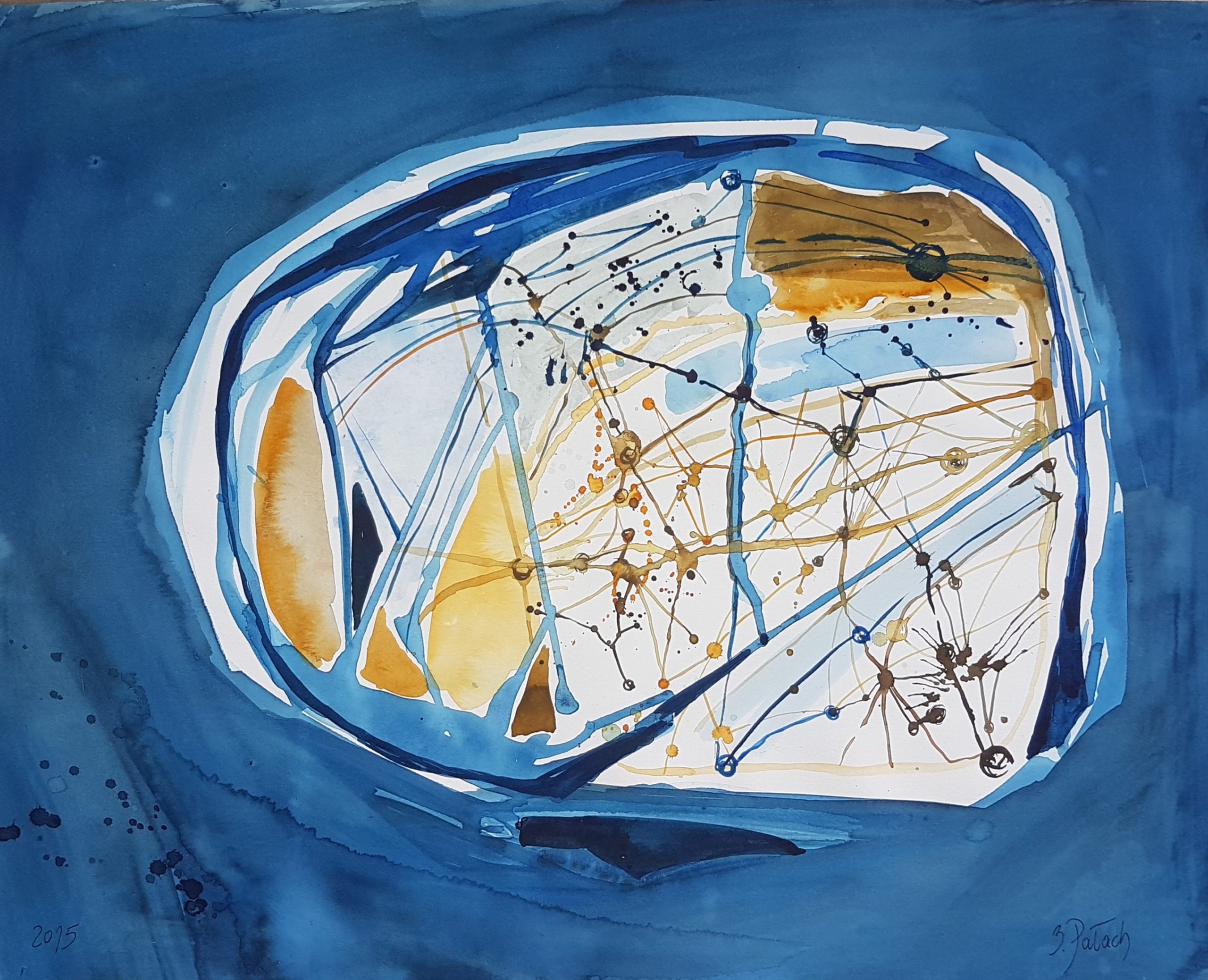

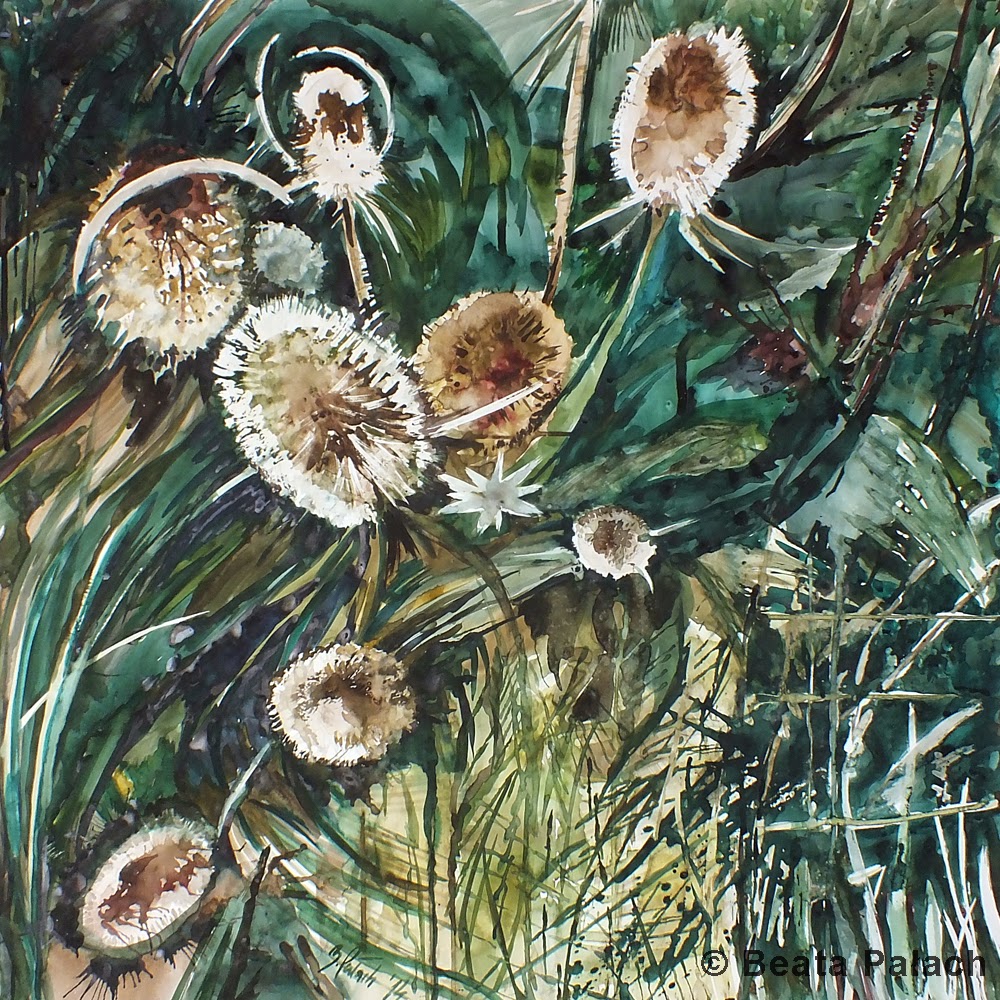
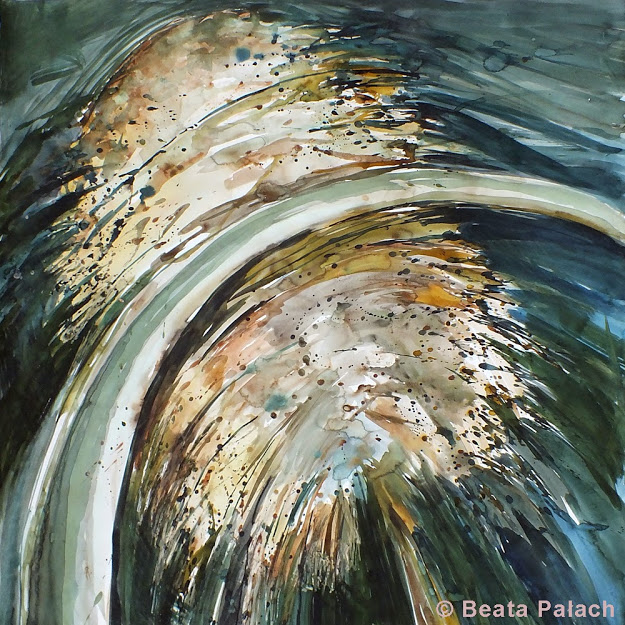
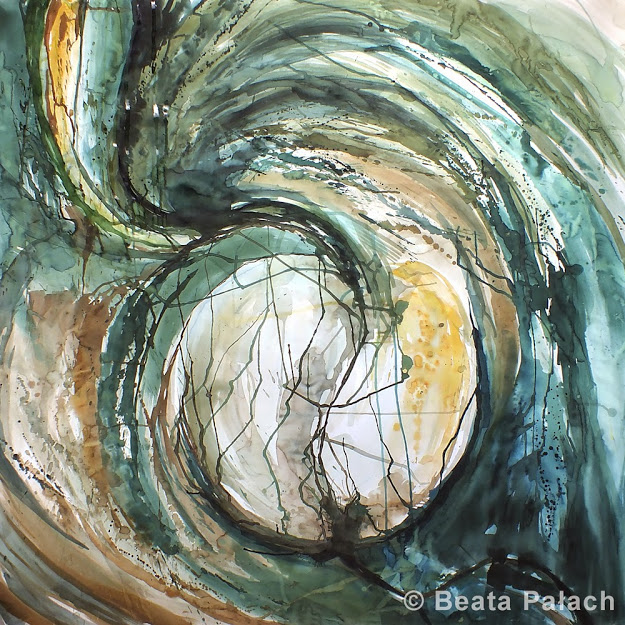
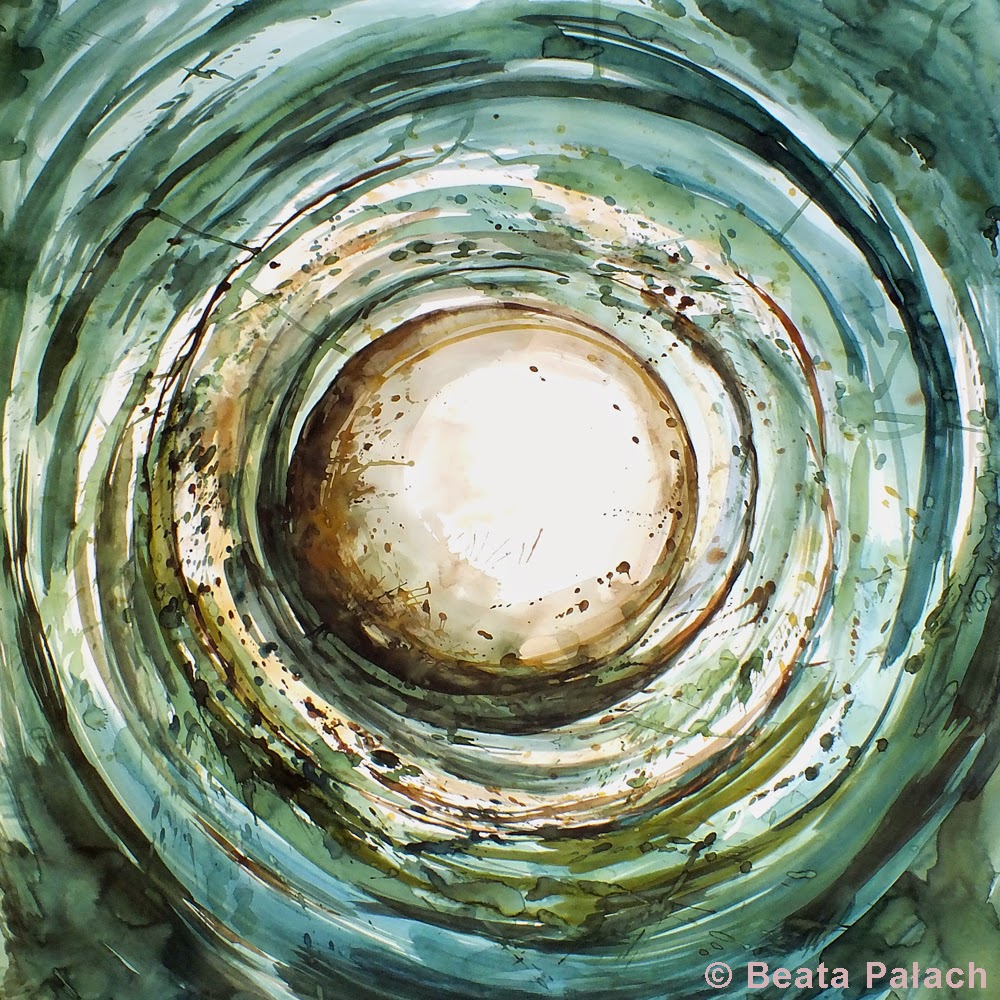
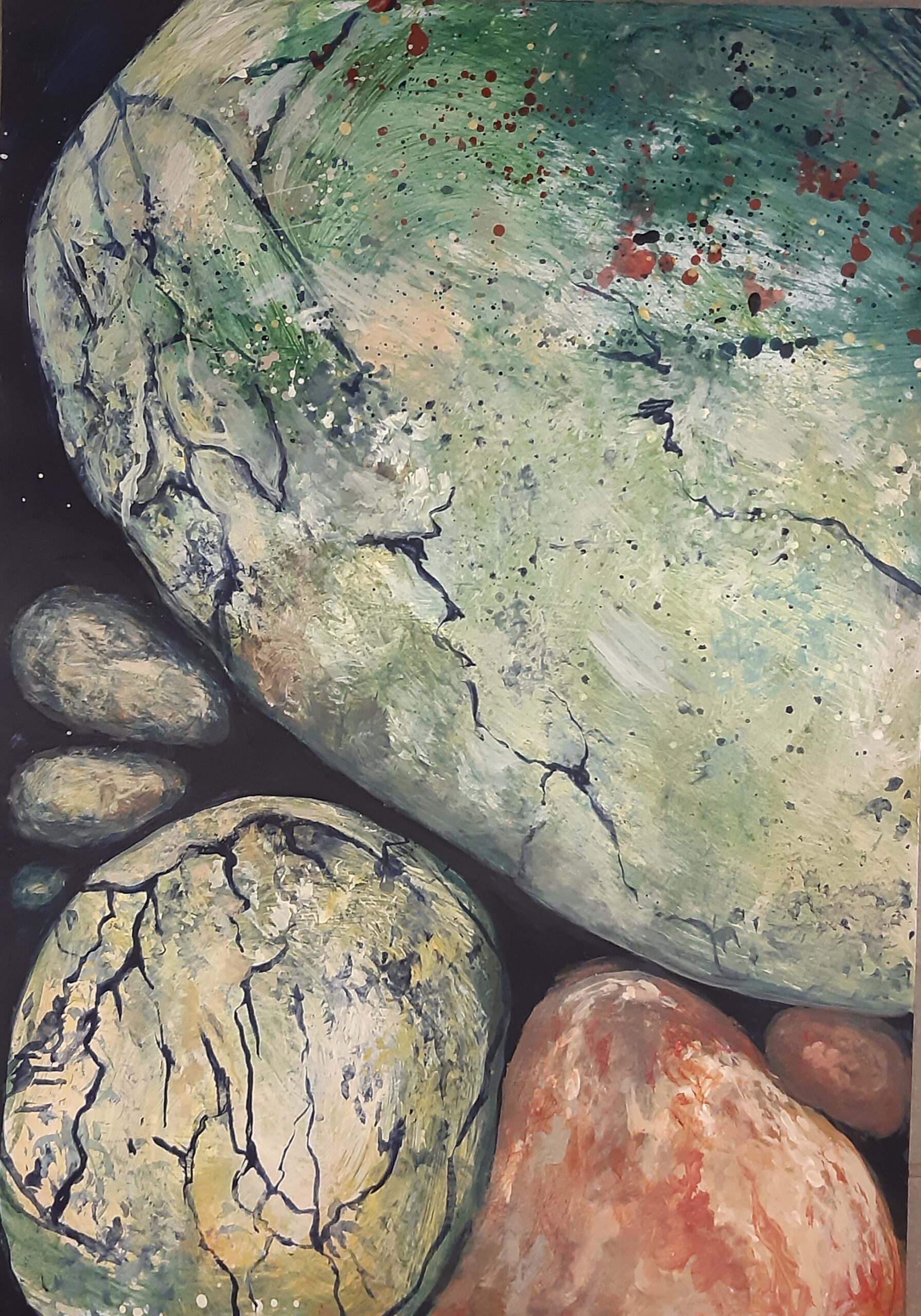
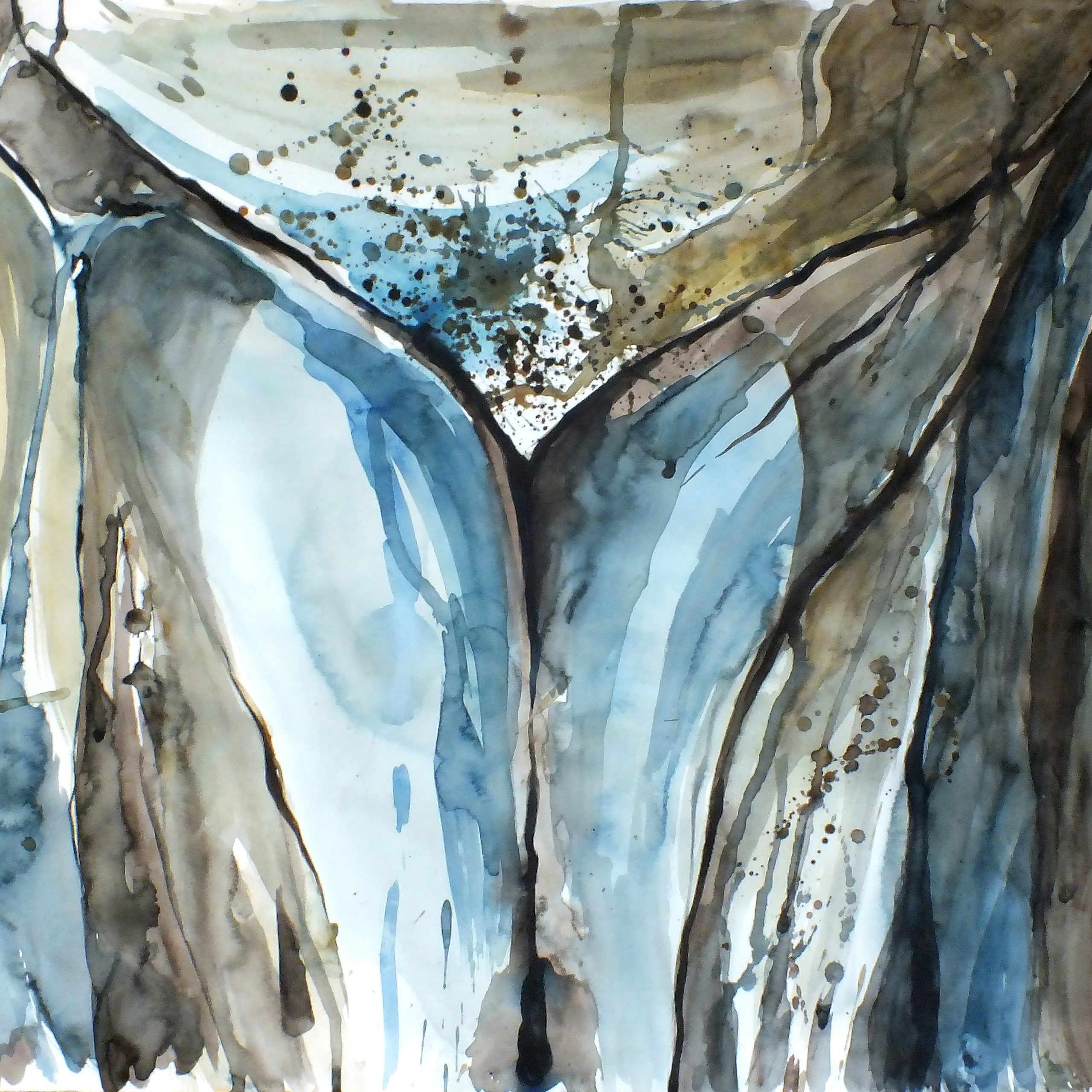
In this watercolour series Beata clearly refers to the experience of abstract expressionism. Her paintings based on a spontaneous gesture and free composition however create coherent forms and shapes. Soft, organic lines, splashes stopped in motion, dark rusty or deep green stains, seemingly uncontrolled, seem to be consciously integrated into the context of the works. These paintings are inspired by the artist’s childhood memories, impressions from the trip and places important to her. These works are dominated by morphic shapes resembling water eddies, rock structures, geological formations or plant cross-sections.
I remember those magical moments from my childhood when I came face to face with the genius of nature. These great discoveries, when raindrops created a masterpiece on the glass pane, or a puddle stirred with a stick formed waves of intriguing shapes. I imagined then that the raindrops flowing down were rising rivers, and the swirling puddle is a bottomless ocean. A scrap of the yard was an unconcealed world … These moments of childhood delight come back to me during my journeys, even the very small ones like the nearby forest. These impressions cannot be recorded either by photography or by a careful sketch. Watercolour seems to me the closest to nature, because it similarly evades attempts to be tamed.
See also: Solo exhibition in Rubinstein.



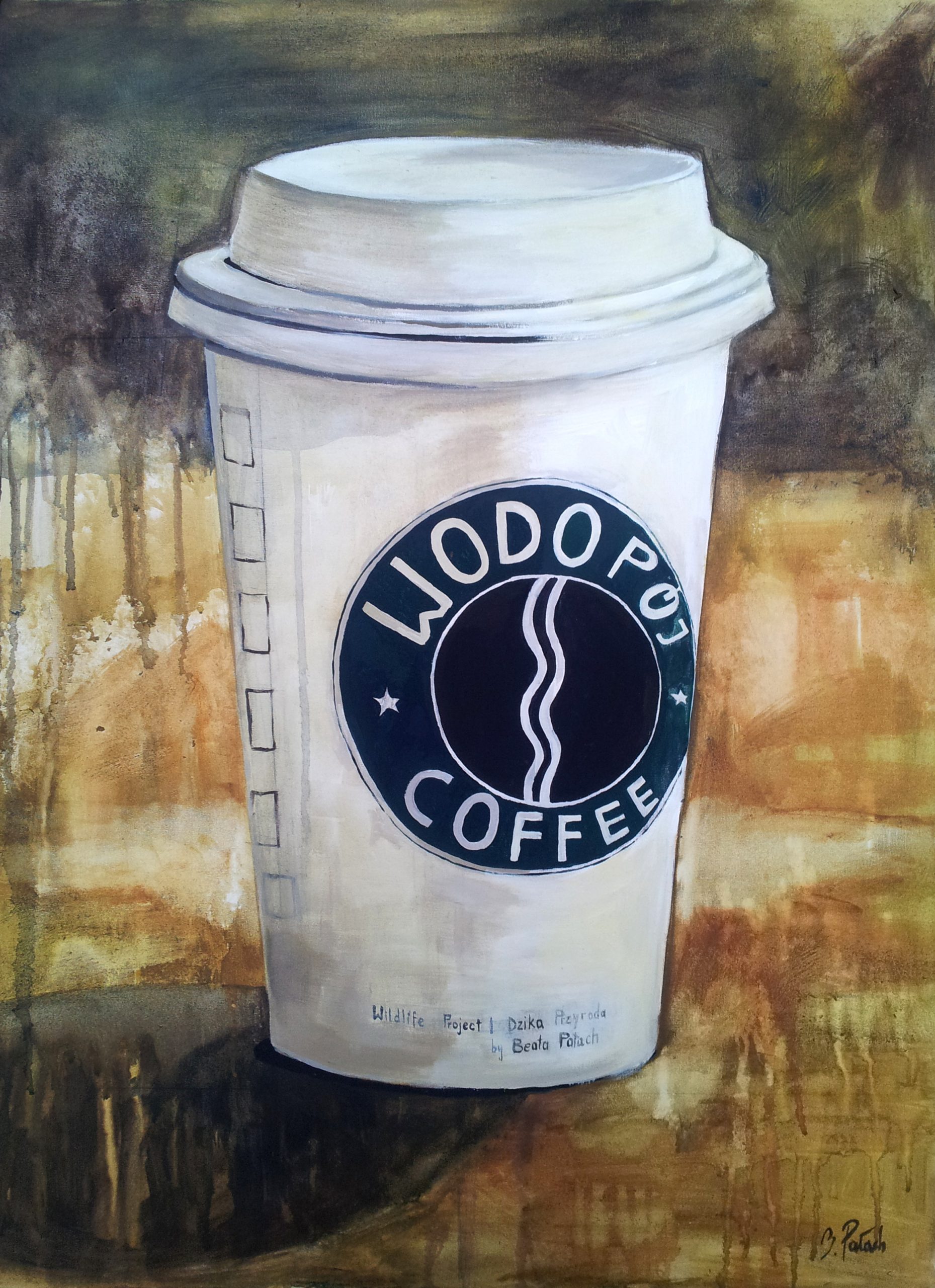
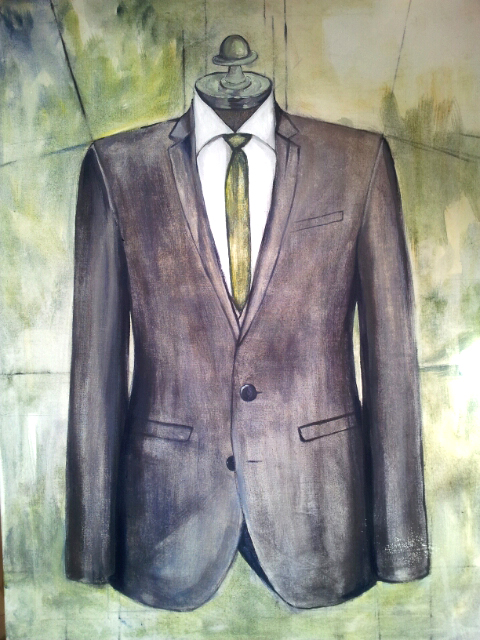
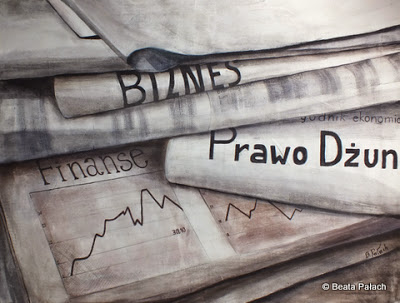
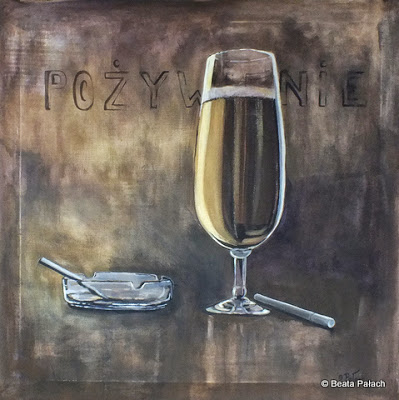

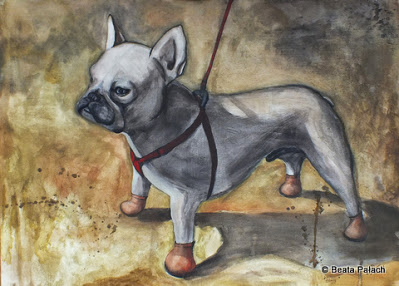
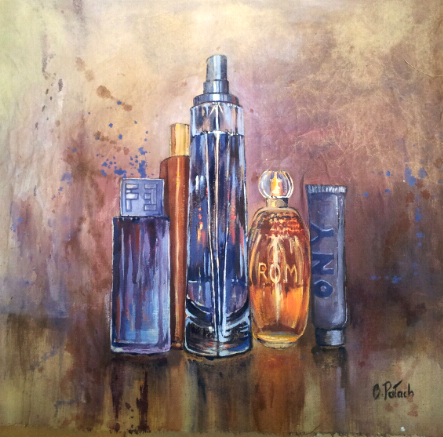

The series “Wild Life” is a satirical commentary on the modern lifestyle of western civilization using symbols of our everyday life.
Flora, Mimicry, Pheromones, Food, Nest, Watering hole, and Law of the Jungle – these subjects are transposed to human behaviour and habits. Still implicated in our animal instincts, we effectively try to mask or deform them. Water and sustenance is replaced by coffee, beer and cigarettes. While uniforms and cosmetics seems to be crucial for our survival in the city jungle. Even so, the primitive instinct of caring for offspring, or the desire to be closer to nature has been embroiled in a thicket of unnecessary but tempting items, without which we can not imagine our existence.
The intention of the author was to confront the pop-art style of the object with the colours inspired by nature (sand, clay, stone, trees, forest) and clearly emphasise the contrast between the dual nature of the homo sapiens species.
The “Elements” series is a collection of watercolour on paper. Like the series “Herbariums” and “Raw”, the pieces from this series are my intimate diaries of impressions and reflections on the surrounding nature, its mystery and unpredictability. It is no coincidence that I chose watercolours as the medium for recording my observations. Its delicacy and transparency somehow enforces the authenticity of the painterly gesture, not allowing to cover up a spontaneous move. Each layer of a colour spot leaves a trace which – just like in nature – is an important part of the painting’s ecosystem.
Read more about this series in the review by Michał Baca